A looming budget cut has led the Forest service to hit pause on seasonal staff hires and hiring external candidates for permanent agency positions, prompting concerns about the agency’s ability to achieve its mission.


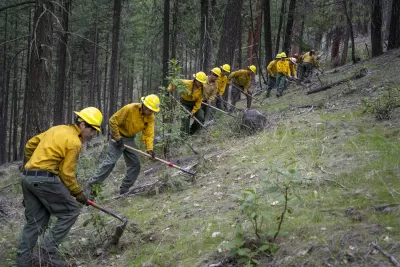
The U.S. Forest Service recently announced a hiring freeze for seasonal staff and announced it won’t be hiring external candidates for any position within the agency in the 2025 fiscal year, according to an article from High Country News, in collaboration with Vox. The decision comes as the agency faces a “looming budget cut” after a recent spending bill passed by the U.S. House of Representatives granted around half a billion dollars less than the Forest Service requested. “All of this, combined with recent cost-of-living increases for staff, means that the agency is feeling strapped for cash,” writes High Country News contributing editor Nick Bowlin. The situation has sent ripples of shock across the nation, raising concerns that thousands of people will be left out of work and that essential conservation and biodiversity work will be at risk. The freeze does not apply to the 11,000 temporary firefighting positions the Forest Service hires annually.
Bowlin explains the scale of the problem: “Americans visit hiking and camping areas managed by the U.S. Forest Service more than 150 million times each year …. The agency relies on a large, often underappreciated army of seasonal or temporary workers who clean bathrooms and campgrounds, empty trash cans, maintain trails, welcome people at visitor centers and do critical research work on the environment.” Without seasonal workers, those tasks will have to be performed by full-time staff, pulling them away from their core duties, or left undone entirely. “And since seasonal work is a common steppingstone to a permanent role, many temporary workers who hoped for a career in public-land management now find themselves at a loss.” Also at risk is the skill and knowledge of long-time seasonal workers who may not return if and when the freeze is lifted.
The High Country News article outlines the extent of work performed by seasonal staff not only to maintain hiking and camping areas but also to clear brush and trees to reduce wildfire risk, manage wildlife habitat, and more. It also highlights interviews and concerns from forestry and conservation advocates, seasonal and permanent Forest Service employees, and public-private partners.
Read the full story: The Forest Service is cutting its seasonal workforce and public lands will suffer

New Executive Order Renews Attack on Public Lands
An order issued late last week pushes for increased mineral extraction on federally owned public lands.
More States Push Back on BLM’s Conservation Rule
Twelve states and industry groups are supporting Utah’s lawsuit against the Bureau of Land Management, arguing the agency can’t bar extractive uses on ‘unappropriated’ public lands.
Industry Groups Sue BLM Over Public Lands Rule
Farmers, ranchers, and others are challenging a policy change that puts conservation on the same footing as other land uses.

Planetizen Federal Action Tracker
A weekly monitor of how Trump’s orders and actions are impacting planners and planning in America.

Amtrak, CN end decades-long dispute with eight-year agreement
The new operating agreement establishes an updated framework for the companies to work together, including processes to resolve disputes.

Judges permit Denver to divert 77,000 acre feet from the Colorado River for reservoir expansion
Overuse and climate change have caused the Colorado River’s water levels to plummet.

NYC DOT wants faster, more permanent street upgrades
The city is examining ways to build more concrete infrastructure without getting entangled in 'decades-long' projects.

'Something we’ve never seen before:' rising utility rates could strain city finances nationwide
Data centers, climate change and other factors have caused utility rates in the United States to increase by 38% since 2020.

Trump to overrule local leaders, lease millions of acres of America’s Pacific Island territories’ seafloors to mining companies
International law says that the Indigenous people of America’s territories have a right to prior and informed consent regarding projects that impact their countries.

FREE Course: Walkable City 1: Why Walkability?
After describing his path towards focusing on walkability as the essence of good planning, Jeff Speck marches through his five principal reasons for making more walkable places.
Reinventing Malls: Planning Alchemy—Turning Gray Fields Into Gold
The course focuses on the opportunities and imperatives that shape reinvention of mall sites.

Harvard University Graduate School of Design
KFH Group Inc.
Greater Baltimore Committee
The Architects Foundation
University of Cincinnati Online
The Pocatello Development Authority
The Urban Renewal Agency of the City of Pocatello