Monday’s solar eclipse will bring increased traffic to parts of the country in its path.



The Genesee Transportation Council in the Genesee-Finger Lakes region of New York is preparing for next Monday’s solar eclipse, hoping to manage the traffic that the once-in-a-lifetime event will inevitably bring to the area.
According to a Smart Cities Dive piece by Ysabelle Kempe, “Traffic and safety concerns are top of mind for Stack and others working to ready their cities for visitors. GTC used flow maps and its data on average rush hour traffic in the Rochester region to predict the routes that will experience the most congestion in the hours after the eclipse.”
Other parts of the country in the path of the eclipse are concerned, too. “Wyoming’s Department of Transportation spokesperson recently told Texas officials that in 2017, when it was in the path of totality, the state doubled its small population, from about 580,000 people to up to 1.5 million, and the roads were ‘completely overwhelmed.’”
Kempe adds, “It’s unusual for hundreds of thousands of people to gather like this, especially in smaller towns that don’t usually see such tourism. There’s a huge economic stimulus aspect to the eclipse, and many towns are hosting educational events and watch parties to celebrate.”
Read the full story: A traffic ‘mass exodus’ may follow the April 8 eclipse. Here’s how one region is preparing.

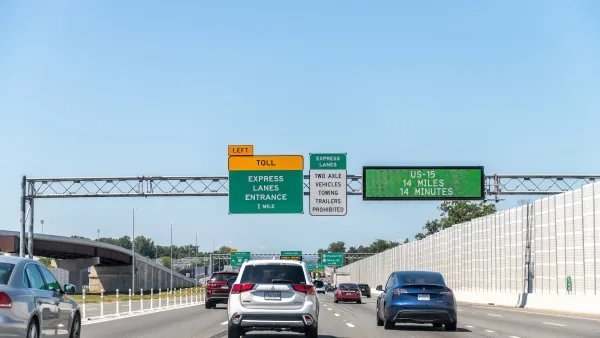
Congestion Costing Reality Check, Part 2: A congestion costing critique
There are good reasons to be skeptical of highway industry claims that traffic congestion is a growing problem. Their analysis is often incomplete and biased. Let’s pull back the curtain on some major congestion cost studies.
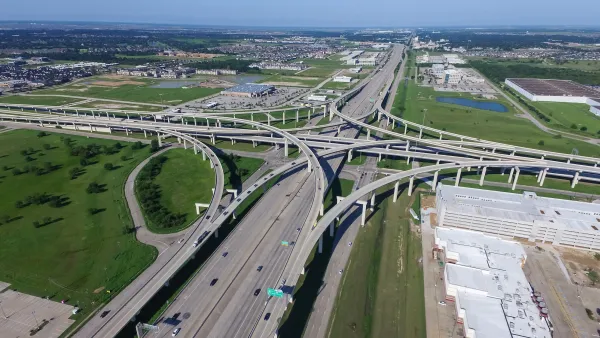
Induced demand is real: Commutes on Houston's 26-lane freeway take 51% longer after expansion
A massive freeway expansion only led to longer drive times, showing that building more lanes won't solve congestion.
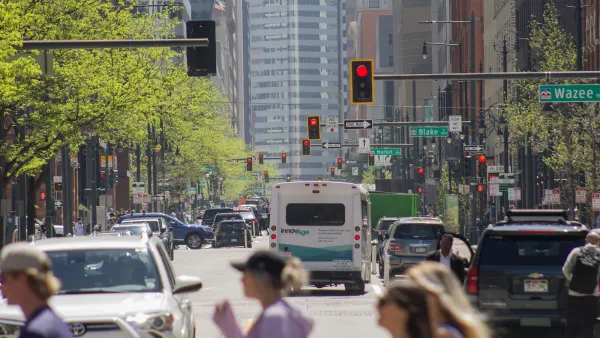
Congestion Costing Reality Check, Part 1: Congestion evaluation best practices
Widely cited studies claim that traffic congestion is a huge and growing problem. They exaggerate. Let’s examine how to correctly calculate congestion costs and roadway expansion benefits.

Planetizen Federal Action Tracker
A weekly monitor of how Trump’s orders and actions are impacting planners and planning in America.

Amtrak, CN end decades-long dispute with eight-year agreement
The new operating agreement establishes an updated framework for the companies to work together, including processes to resolve disputes.

Judges permit Denver to divert 77,000 acre feet from the Colorado River for reservoir expansion
Overuse and climate change have caused the Colorado River’s water levels to plummet.

NYC releases high-tech public restrooms — with a 10 minute time limit
The $4 million pilot program aims to make it easier for people to find public restrooms in New York City.

Alabama scores up to $2.5 billion federal loan for largest infrastructure project in state’s history
The Mobile River Bridge and Bayway Project aims to ease congestion at Alabama’s worst bottleneck.

Trump is considering data centers on 6 states' public land — some state officials say they had no idea
If the administration approves the proposed projects, data center and data center-related developments will cover 17,600 acres of public land.

FREE Course: Walkable City 1: Why Walkability?
After describing his path towards focusing on walkability as the essence of good planning, Jeff Speck marches through his five principal reasons for making more walkable places.
Reinventing Malls: Planning Alchemy—Turning Gray Fields Into Gold
The course focuses on the opportunities and imperatives that shape reinvention of mall sites.

KFH Group Inc.
Greater Baltimore Committee
Eagle County Government
The Architects Foundation
University of Cincinnati Online
The Pocatello Development Authority
The Urban Renewal Agency of the City of Pocatello