The proposed Dorchester Greenway would create a new linear park above part of the Red Line subway.


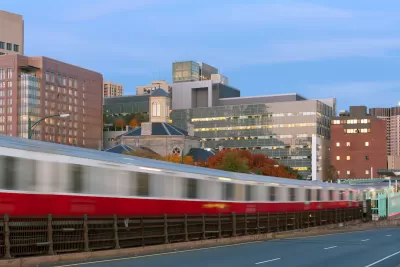
A proposed greenway would cap a 0.75-mile subterranean segment of Boston’s Red Line subway with a linear park, reports Daniel Roche in The Architect’s Newspaper. “With $300,000 in funding from the MassTrails program, a state initiative, and an additional $368,000 from the city of Boston; officials, community leaders, and designers are gearing up to build a new pathway for walkers and bikers, dubbed The Dorchester Greenway.”
According to Roche, “Today, the stretch between Fields Corner Station and Ashmont Station is below grade, topped by a derelict asphalt carpet. For years, community activists have sought to build a park on the land currently owned by the Massachusetts Bay Transportation Authority (MBTA).” Local advocates say the greenway would provide new public green space and stitch the neighborhood back together. Cap parks are becoming an increasingly popular way to utilize space above active or defunct freeways or subway lines, although some projects, like one in Denver, have triggered gentrification and displacement concerns.
Read the full story: The Dorchester Greenway, a speculative linear park, may soon be built in Boston over the Red Line

I Help Plan Cap Parks; Here’s What Austin Can Learn from Other Cities
How freeway capping projects can literally and metaphorically bridge urban divides.
The Massachusetts town that didn't get the T wants a re-do
Fifty years ago, Arlington said no to a stop on the MBTA Red Line connecting it to Boston. Now, the town wants a second chance.
Austin Officials Pump the Brakes on I-35 ‘Cap & Stitch’ Project
The city approved a plan to build cap parks over parts of I-35 less than a year ago.

Planetizen Federal Action Tracker
A weekly monitor of how Trump’s orders and actions are impacting planners and planning in America.

California plans to bury El Niño’s downpour
If the state plays its cards right, it may be able to store a billion acre-feet of El Niño’s water in aquifers.

Chicago breaks ground on $3 billion megadevelopment
The new neighborhood, titled Foundry Park, will one day host 3,700 residences.

Satanic place names
From streams and lakes to valleys and canyons, I mapped more than 1,000 places named after the Devil.

California High-Speed Rail Authority CEO resigns after $600,000 scandal
Under Ian Choudri, the authority used taxpayer dollars to fund first class flights and trips to nightclubs.

Want to study the Missouri River? Soon, you may need unanimous approval from 10 states
Legislation would require 10 governors’ permission to study or build projects moving water outside the basin.

FREE Course: Walkable City 1: Why Walkability?
After describing his path towards focusing on walkability as the essence of good planning, Jeff Speck marches through his five principal reasons for making more walkable places.
Reinventing Malls: Planning Alchemy—Turning Gray Fields Into Gold
The course focuses on the opportunities and imperatives that shape reinvention of mall sites.

City of Rosemead
Rutgers University, Edward J. Bloustein School of Planning and Public Policy
One Hundred Miles
Hunter College, City University of New York (CUNY)
The Architects Foundation
University of Cincinnati Online
City of Cambridge
Montrose County
The Pocatello Development Authority