Where do the iconic trees go after the holidays?


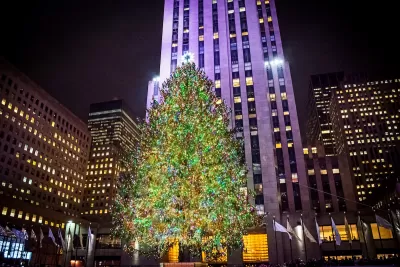
Have you ever wondered what happens to the famously massive Rockefeller Center Christmas trees that adorn one of New York City’s most recognizable public spaces each holiday season? An article by Eric Lagatta in USA Today has the answer, and it’s surprisingly relevant to Planetizen readers: “For the past 16 years, lumber milled from the trees has been donated to Habitat for Humanity and used to construct new homes.”
“At the end of the season, the Christmas tree is taken down and cut into large pieces, which are transported to a mill in New Jersey where the initial rough sawing is done, Habitat spokeswoman Erika Bowditch told USA TODAY. From there, the pieces are brought to a landscaping company to be dried in a kiln, milled and planed until they are soft and smooth.” The lumber is then sent to a Habitat project to be used in construction.
The trees have been used in homes in five states. “In most cases, the Christmas tree lumber is sent to a Habitat affiliate in the state where the tree was grown.”
Read the full story: What happens to Rockefeller Christmas trees after they come down? It’s a worthy new purpose.

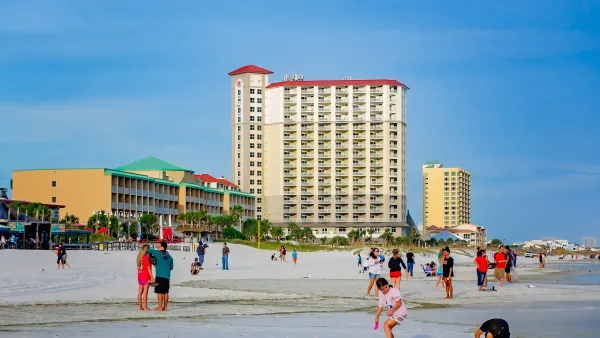
Pensacola to build first ever permanent affordable housing
The Community Land Trust development will use a shared equity model to keep homes affordable for the next 99 years.

Houston Habitat for Humanity builds modular homes in one-third the construction time of traditional houses
The nonprofit known for facilitating affordable homeownership is working to cut costs as traditional construction becomes more expensive.
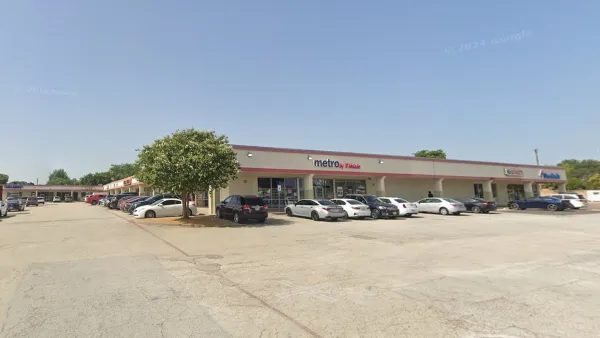
Adaptive Reuse Will Create Housing in a Suburban Texas Strip Mall
A developer is reimagining a strip mall property as a mixed-use complex with housing and retail.

Planetizen Federal Action Tracker
A weekly monitor of how Trump’s orders and actions are impacting planners and planning in America.

California plans to bury El Niño’s downpour
If the state plays its cards right, it may be able to store a billion acre-feet of El Niño’s water in aquifers.

Chicago breaks ground on $3 billion megadevelopment
The new neighborhood, titled Foundry Park, will one day host 3,700 residences.

California High-Speed Rail Authority CEO resigns after $600,000 scandal
Under Ian Choudri, the authority used taxpayer dollars to fund first class flights and trips to nightclubs.

Want to study the Missouri River? Soon, you may need unanimous approval from 10 states
Legislation would require 10 governors’ permission to study or build projects moving water outside the basin.

Desperate measures: Advocates weigh draining Lake Powell to fill Colorado River
Draining the reservoir could reduce evaporation losses by a couple hundred thousand acre-feet.

FREE Course: Walkable City 1: Why Walkability?
After describing his path towards focusing on walkability as the essence of good planning, Jeff Speck marches through his five principal reasons for making more walkable places.
Reinventing Malls: Planning Alchemy—Turning Gray Fields Into Gold
The course focuses on the opportunities and imperatives that shape reinvention of mall sites.

City of Rosemead
Rutgers University, Edward J. Bloustein School of Planning and Public Policy
One Hundred Miles
Hunter College, City University of New York (CUNY)
The Architects Foundation
University of Cincinnati Online
City of Cambridge
Montrose County
The Pocatello Development Authority