The city is starting to develop a plan for adding more public restrooms downtown, where available bathrooms are scarce and historic buildings are being damaged by public urination.


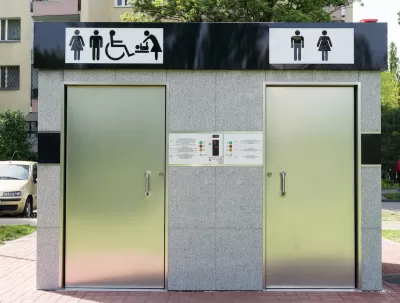
Baltimore city officials announced an effort to install public restrooms in the city’s downtown as part of an effort to provide more access to bathrooms and preserve historic buildings, many of which are slowly being damaged by urine. Public bathrooms can be a crucial lifeline for unhoused people, as well as a major convenience for anyone walking around a city.
As Brenna Smith explains in The Baltimore Banner, “The city’s lack of public restrooms is almost as historic as its buildings. Despite the homeless community asking for decades, the city resisted erecting more until recently.” Homeless advocates say the lack of public restrooms poses health risks and increases risk for unhoused people who have to find isolated places to go. “There are well-documented medical consequences to holding urine for too long. The National Institute of Health found it increased the likelihood of bladder infections, and according to Harvard Medical School, it can even make it harder to relieve yourself over time,” Smith points out.
The city is looking to Portland, Oregon for an example of a durable, safe public restroom design dubbed the Portland Loo, but a final budget, design, and locations, have not been selected.
FULL STORY: A steady stream of pee is eroding Baltimore’s historic buildings

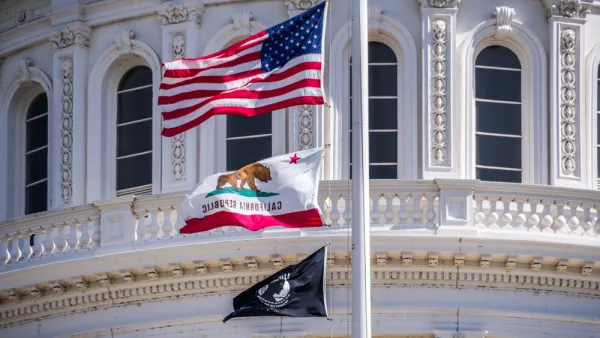
Election 2024: California Voters to Decide on $6 Billion Homelessness Bond
Gov. Gavin Newsom signed two ‘behavioral health’ bills that put Proposition 1 on the March 2024 ballot, targeting the housing, mental health, and substance use treatment needs of homeless residents living in encampments. Opposition has arisen.

LA has no plan — or funding — to help unhoused people displaced by Olympics security efforts
City and county officials say they don't have the funds to offer housing to the up to 1,600 people that will be displaced by perimeters around event venues.
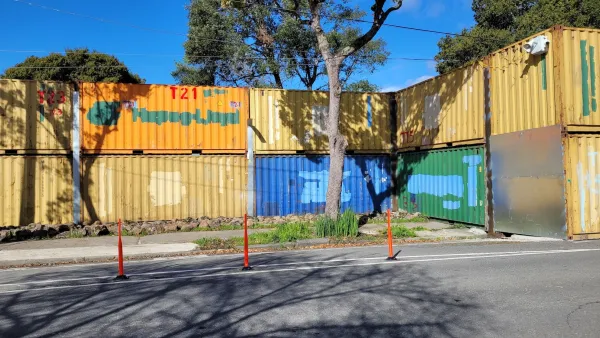
Berkeley promised to build supportive housing in People's Park. Where is it?
More than two years after People's Park was cordoned off, there is no word on a timeline for a promised affordable housing project.

Planetizen Federal Action Tracker
A weekly monitor of how Trump’s orders and actions are impacting planners and planning in America.

The state-sanctioned urbicide of Austin
People don’t kill cities. Freeways do.

US to reduce Colorado River water deliveries to Mexico
A new Colorado Treaty amendment reduces Mexico’s Colorado River water allocation by 250,000 acre feet.

5 New England states march closer to 800 megawatt wind energy project
Securing federal approval for the project may be complicated under the Trump administration, which has historically been hostile towards domestic wind power.

Baltimore to break ground on $50 million Transit Priority Project
The project will bring faster bus trips, safer streets and better bike connections to Baltimore.

Airbnb launches $250 million 'last-dollar financing' housing accelerator, makes first investment in Austin
The company will put $6.4 million towards affordable housing development in Texas’ capital.

FREE Course: Walkable City 1: Why Walkability?
After describing his path towards focusing on walkability as the essence of good planning, Jeff Speck marches through his five principal reasons for making more walkable places.
Reinventing Malls: Planning Alchemy—Turning Gray Fields Into Gold
The course focuses on the opportunities and imperatives that shape reinvention of mall sites.

Eagle County Government
Harvard University Graduate School of Design
Nashville Planning Department
The Architects Foundation
University of Cincinnati Online
The Pocatello Development Authority
The Urban Renewal Agency of the City of Pocatello
Journal of the American Planning Association