The city is promoting quick-build, low-cost solutions to stem the homelessness crisis.


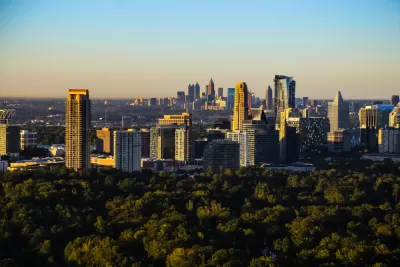
“The Invest Atlanta Board of Directors has approved a line of credit up to $7.5 million that will fund so-called rapid housing initiatives in Atlanta, as financed through the city's Housing Opportunity Bond Fund,” reports Josh Green in Urbanize Atlanta. “All units will aim to provide low-barrier alternatives to traditional shelters with access to wraparound services such as healthcare and employment, per city officials.”
The funding is meant to kickstart the building of “flexible communities” with 500 ‘micro’ housing units for unhoused residents. “In August, the city unveiled plans to build temporary homeless housing from former shipping containers on a South Downtown parking lot on Forsyth Street and another on underused property in Mechanicsville—the latter involving a land swap with Atlanta Public Schools.”
The Forsyth Street location sits near a MARTA transit station. “The strategy calls for using shipping containers—many of them donated by the Georgia Emergency Management Agency, following use as temporary COVID-19 hospital facilities—as a relatively cheap, quick means of delivering rapid housing options.”
Read the full story: Funding OK'd for 500 micro units to address Atlanta homelessness

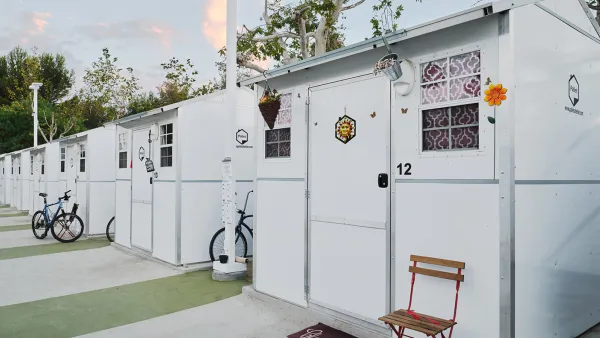
The Role of Microhousing in Ending Chronic Homelessness
Affordable, quick-build ‘tiny homes’ can serve as a key stepping stone to a permanent housing situation for people experiencing homelessness.
Local Governments Sue HUD Over Funding Cuts
A new lawsuit alleges that the Trump administration’s revised guidelines for housing and homelessness assistance funds will decimate key programs.

Safe Parking Programs Help People Access Housing
The safety and stability offered by Safe Parking sites have helped 40 percent of unhoused San Diego residents who accessed these programs get into permanent housing.

Planetizen Federal Action Tracker
A weekly monitor of how Trump’s orders and actions are impacting planners and planning in America.

The state-sanctioned urbicide of Austin
People don’t kill cities. Freeways do.

Colorado’s Largest Data Center Could Rise Next to Homes — Without a Public Hearing
The proposed campus would consume 11 times the power of Denver International Airport; as it has across the country, opposition mounts.

Nation's most wind-powered state turns to coal as data centers increase energy demand
For the first time in decades, Iowa has increased its generation of coal power.

NYC cools commuters with city's first rain garden above a bus stop
New York City officials say the plants in the rain garden can absorb 16 gallons of rainwater during heavy storms.

Brightline West’s future may rely on $6 billion federal loan
The company has until Nov. 2 to make a $400 million equity investment into its proposed high-speed rail line.

FREE Course: Walkable City 1: Why Walkability?
After describing his path towards focusing on walkability as the essence of good planning, Jeff Speck marches through his five principal reasons for making more walkable places.
Reinventing Malls: Planning Alchemy—Turning Gray Fields Into Gold
The course focuses on the opportunities and imperatives that shape reinvention of mall sites.

Greater Baltimore Committee
Eagle County Government
Harvard University Graduate School of Design
The Architects Foundation
University of Cincinnati Online
The Pocatello Development Authority
The Urban Renewal Agency of the City of Pocatello
Journal of the American Planning Association