A New Mexico research program will assess the health of seedlings to understand which trees will be most resilient to climate risks.


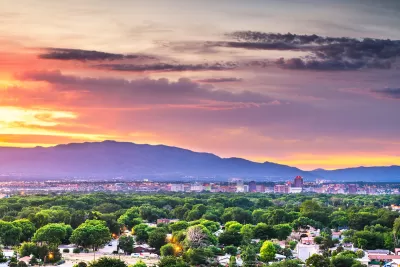
In an article for Route Fifty, Kaitlyn Levinson reminds readers that planting trees is only part of the equation when it comes to boosting urban tree canopies, creating shade, and cooling city sidewalks.
Urban trees also need to be resilient to weather, climate risks, and other factors for the long term. A new program at New Mexico’s Energy, Minerals and Natural Resources Department (EMNRD), the Climate Ready Trees Program, “aims to help officials identify which tree types will most likely withstand New Mexico’s changing climate so they can be incorporated into future urban landscapes.”
The program will use long-range data gained from tree seedlings to understand which trees fare best in varying local conditions. The seedlings can be adopted by schools, libraries, and other institutions. “Participants are required to maintain the trees on their properties in demonstration gardens and submit an annual tree performance survey to the Forestry Division so officials can track the tree growth process.”
Read the full story: Tree nurseries sprout up as a climate mitigation strategy

Improving South Los Angeles Through Strategic Tree Planting
The University of Southern California Urban Trees Initiative is planting 250 trees in South L.A. neighborhoods to improve shade, combat climate change, and enhance community well-being through collaboration and data-driven approaches.
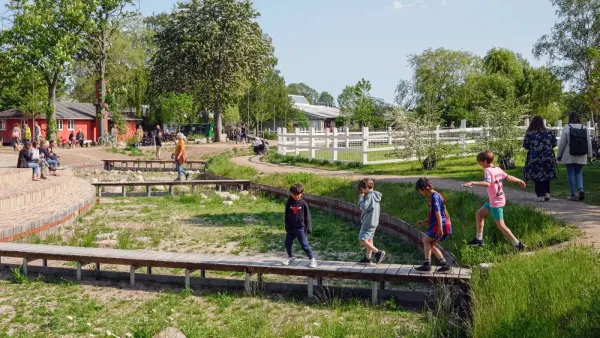
Copenhagen is losing its cool
In a city long designed to maximize light during dark Scandinavian winters, climate change is forcing the Danish capital to rethink its relationship with the sun.

Planting for Change: How Trees Are Powering Climate Action
"Combating Climate Change with Trees" highlights how Southern California communities are strategically planting and nurturing urban forests to cool neighborhoods, improve air quality, and advance environmental justice.

Planetizen Federal Action Tracker
A weekly monitor of how Trump’s orders and actions are impacting planners and planning in America.

California plans to bury El Niño’s downpour
If the state plays its cards right, it may be able to store a billion acre-feet of El Niño’s water in aquifers.

Desperate measures: Advocates weigh draining Lake Powell to fill Colorado River
Draining the reservoir could reduce evaporation losses by a couple hundred thousand acre-feet.

In Texas, data centers are swallowing promised parkland
Residents who moved to Taylor, Texas for a rural community now have to contend with three data centers in their backyard.

How a Chicago-sized wind farm beat the odds and powered on
The project spanned five presidential administrations and a standoff with a U.S. military base.

MTA gives itself 30 days to transform pit into basketball court
The site has been under construction since 2022; the city originally estimated it would finish the court in 2024.

FREE Course: Walkable City 1: Why Walkability?
After describing his path towards focusing on walkability as the essence of good planning, Jeff Speck marches through his five principal reasons for making more walkable places.
Reinventing Malls: Planning Alchemy—Turning Gray Fields Into Gold
The course focuses on the opportunities and imperatives that shape reinvention of mall sites.

City of Rosemead
Rutgers University, Edward J. Bloustein School of Planning and Public Policy
One Hundred Miles
Hunter College, City University of New York (CUNY)
The Architects Foundation
University of Cincinnati Online
City of Cambridge
Montrose County
The Pocatello Development Authority