The borough’s council voted to reverse its decision to demolish several legacy businesses to build a new parking garage.


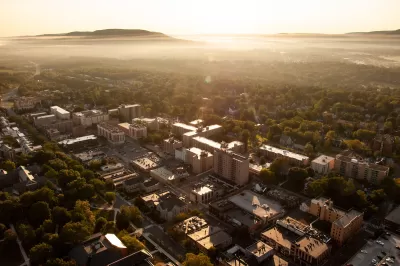
When the community of State College, Pennsylvania decided to demolish three downtown businesses via eminent domain to make way for a new parking garage, local residents mobilized to fight the project. As Asia Mieleszko writes in Strong Towns, the group, Strong Towns Happy Valley, gathered local support to rescind the decision.
Business owner Jay Horgas, who owns one of the buildings in question, says he was told several years ago his business would not be in danger. “Furthermore, when all was said and done, he was never personally notified. Instead, he learned he’d lose his business, The Brewery, in operation since the 1960s, when a reporter reached out for comment on August 7.”
According to Mieleszko, “The immediate vicinity is served by several paid parking lots, garages, and on-street parking: the crumbling yet still operational Pugh Street Garage is a block away, the block of the bar has the McAllister Parking Deck, and a five-minute walk produces at least two parking lots and the Fraser Street Garage.” Parking amounts to roughly 20 percent of the area’s commercial district. Many of them have “plenty of spaces available” even during the busiest times, like Penn State college football game days.
After a petition protesting the project garnered 5,000 signatures and with hundreds of people present in person and virtually to protest the project at an August 21 council meeting, the borough council brought the issue to a vote and reversed the decision. While the parking garage isn’t entirely off the table, the move signals the importance of grassroots organizing.
FULL STORY: State College Chose Parking Over People. The People Fought Back.

Retrofitting Parking Garages to Create New Housing
Underused parking garages and lots offer an opportunity to alleviate the housing crisis by retrofitting them with temporary and permanent housing options.

Strong Towns: For Better Cities, End Parking Subsidies
The parking mandates and subsidies prevalent in American cities stifle development and remove agency from property owners and residents.

One Pandemic Real Estate Bet: Condos for Cars
The possibility of many more urban dwellers driving than ever before, even in transit-rich locations like New York City, is still very real.

The state-sanctioned urbicide of Austin
People don’t kill cities. Freeways do.

US to reduce Colorado River water deliveries to Mexico
A new Colorado Treaty amendment reduces Mexico’s Colorado River water allocation by 250,000 acre feet.

New Jersey’s second-largest city bans standalone data centers
Jersey City will continue to allow co-location facilities, such as those meant for research institutions that store their own data.

Amtrak not solely to blame for New Jersey commuter rail's unreliability, report finds
A new study from the Garden State Initiative found that NJ Transit’s budget grew 20% across a 4 year period, but reliability declined significantly over the same period.

EPA erases limits on planet-warming pollution from power plants
Under Monday’s plan, power plants would still have some limits on how much mercury, arsenic and other contaminants they can emit.

Phoenix announces new on-demand transit service, more frequent RAPID buses
Both new services will launch in October, and are part of Phoenix's Project Effective Access Solutions for Easing Congestion.

FREE Course: Walkable City 1: Why Walkability?
After describing his path towards focusing on walkability as the essence of good planning, Jeff Speck marches through his five principal reasons for making more walkable places.
Reinventing Malls: Planning Alchemy—Turning Gray Fields Into Gold
The course focuses on the opportunities and imperatives that shape reinvention of mall sites.

Eagle County Government
Harvard University Graduate School of Design
Nashville Planning Department
The Architects Foundation
University of Cincinnati Online
The Pocatello Development Authority
The Urban Renewal Agency of the City of Pocatello
Journal of the American Planning Association