Some housing experts say the rezoning plan is not nearly ambitious enough to make a dent in the city’s housing crisis.



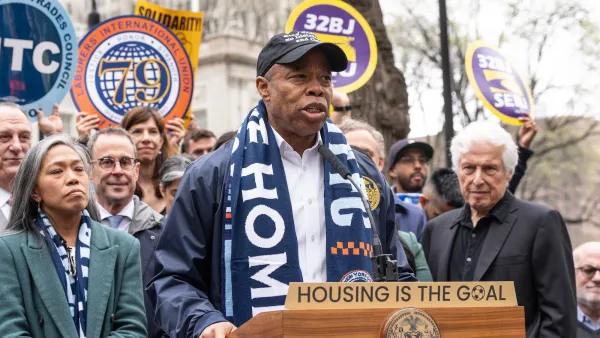
An article by Kriston Capps and Sarah Holder in Bloomberg CityLab outlines the potential benefits and pitfalls of New York City Mayor Eric Adams’ ‘City of Yes’ zoning reform proposal, an ambitious package that aims to create 100,000 new units of housing in the next 15 years.
The package includes eliminating parking requirements, promoting transit-oriented development, legalizing shared housing and accessory dwelling units (ADUs), and encouraging more affordable units, all aimed at making housing more available and affordable. “But all of these outcomes depend on the city building enough housing to truly make a difference — and experts question whether Adams’s plan is ambitious enough to meet that threshold,” the authors write.
Some experts say the scale of the zoning changes, like permitting three-to-five story apartment buildings near transit stops in the outer boroughs, may not be enough to make a difference in housing costs and could counterintuitively lead to displacement of older residents. “Yonah Freemark, senior research associate for the Urban Institute, said the plan excited him, but warned against relying on zoning changes exclusively to lead to dramatic new housing gains over the short term. His own research finds mixed success on upzoning when it comes to housing production or socioeconomic integration.”
The authors compare the mayor’s housing proposal with that of New York Governor Kathy Hochul, who was unable to get the plan approved during budget negotiations earlier this year. “Many things have to go right for accessory dwelling units, transit-oriented development and other policies to become a reality for more New Yorkers. Whether the Adams administration can build in places where others have failed remains to be seen.”
FULL STORY: Can NYC Ease Housing Costs With ‘City of Yes’ Proposal?


NYC Zoning Reform: Where Will It Have an Impact?
The zoning reform package dubbed ‘City of Yes’ will likely yield uneven results, with many of the lowest-density neighborhoods exempted from new regulations.
What Actually Got Built Under Eric Adams’ ‘Pro-Housing’ Administration
The outgoing mayor claims credit for hundreds of thousands of new homes. The truth is more complicated.

Lawsuit Aims to Stop NYC’s ‘City of Yes’ Zoning Reforms
A lawsuit brought by local lawmakers and community groups claims the plan failed to conduct a comprehensive environmental review.

The state-sanctioned urbicide of Austin
People don’t kill cities. Freeways do.

US to reduce Colorado River water deliveries to Mexico
A new Colorado Treaty amendment reduces Mexico’s Colorado River water allocation by 250,000 acre feet.

New Jersey’s second-largest city bans standalone data centers
Jersey City will continue to allow co-location facilities, such as those meant for research institutions that store their own data.

Amtrak not solely to blame for New Jersey commuter rail's unreliability, report finds
A new study from the Garden State Initiative found that NJ Transit’s budget grew 20% across a 4 year period, but reliability declined significantly over the same period.

EPA erases limits on planet-warming pollution from power plants
Under Monday’s plan, power plants would still have some limits on how much mercury, arsenic and other contaminants they can emit.

Phoenix announces new on-demand transit service, more frequent RAPID buses
Both new services will launch in October, and are part of Phoenix's Project Effective Access Solutions for Easing Congestion.

FREE Course: Walkable City 1: Why Walkability?
After describing his path towards focusing on walkability as the essence of good planning, Jeff Speck marches through his five principal reasons for making more walkable places.
Reinventing Malls: Planning Alchemy—Turning Gray Fields Into Gold
The course focuses on the opportunities and imperatives that shape reinvention of mall sites.

Eagle County Government
Harvard University Graduate School of Design
Nashville Planning Department
The Architects Foundation
University of Cincinnati Online
The Pocatello Development Authority
The Urban Renewal Agency of the City of Pocatello
Journal of the American Planning Association