‘Free’ employee parking increases driving. Parking cash-out laws reward commuters who use climate-friendly modes, which increases fairness and reduces traffic problems.


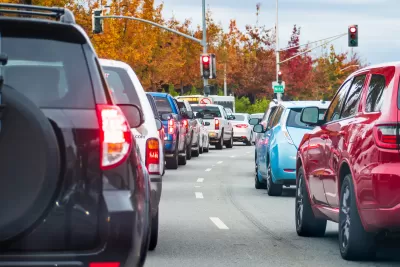
A new study for the Federal Highway Administration, An Assessment of the Expected Impacts of City-Level Parking Cash-Out and Commuter Benefits Ordinances, analyzed and evaluated the effects of parking cash‑out ordinances on vehicle travel, congestion, Greenhouse Gas emissions, crashes, and equity in nine U.S. cities.
Cashing out parking typically reduces affected automobile travel 10-30 percent, depending on the value of the incentive, and various factors. The more flexible the incentive, the greater the impact. For example, parking cash-out tends to cause larger vehicle trip reductions than transit subsidies because it rewards any alternative mode, and daily benefits tend to have larger effects than monthly benefits because they encourage even occasional shifts to non-auto modes.
This study evaluated five scenarios:
1. Monthly Parking Cash-Out: This is an ordinance that requires employers that offer free/subsidized parking to offer employees the option to cash-out their parking on a monthly basis.
2. Monthly Commuter Benefit (Employer-Paid Transit/Vanpool Benefit): This is an ordinance that requires employers providing free/subsidized parking to offer employees a transit or vanpool benefit paid by the employer, but not in excess of the value of the parking benefit.
3. Monthly Parking Cash-Out and Pre-Tax Transit Benefit for Employees Without
Subsidized Parking: In addition to requiring that employers that subsidize parking offer a monthly parking cash-out option (same as Scenario 1), all other employers must make pre-tax transit benefits available to all of their employees. This scenario applies a requirement to all worksites—those that provide free or subsidized parking and those that currently do not.
4. Daily Parking Cash-Out and Pre-Tax Transit Benefit for Employees Without
Subsidized Parking: This scenario is the same as Scenario 3 with the difference that the parking cash-out must be offered as a daily cash-out option, rather than monthly. In addition to requiring that employers that subsidize parking offer a daily parking cash-out option, all other employers must make pre-tax transit benefits available to all of their employees.
5. Requirement to Eliminate Subsidized Parking Benefit + Provide Universal $5 Per Day Employer-Paid Non-SOV Commute Benefit: An ordinance that requires employers that are offering their employees free/subsidized parking to cease offering it and for all employers to offer an employer-paid non-SOV commute benefit of $5 per commute day.
The study estimated that basic monthly cash-out requirements would reduce commute-related VMT by an average of over 7 percent across all analyzed cities, with wide variation among the cities—from about a 3 percent reduction in New York City, where few employees currently receive free parking, to a 13 percent reduction in Philadelphia. Daily versus monthly cash-out policies may yield greater impacts. The most aggressive option tested, which involved eliminating commuter parking subsidies and offering a $5 daily cash benefit to commuters that use non- single occupancy vehicle modes is predicted to reduce commute vehicle travel by 17 percent to 36 percent. Since most of this reduction would occur during peak commute hours, parking cash-out can significantly reduce congestion and other negative traffic externalities.
Yale Climate Connections produced a podcast that summarizes the results of this study:
Read the full story: Parking cash out rewards commuters who use non-auto modes, increasing fairness and reducing traffic problems..


Denver mayor pushes for cheap downtown parking, says promoting transit is 'not our strategy'
The 'Mayor's Park $5' program encourages local businesses to reduce their parking prices to bring more people downtown.
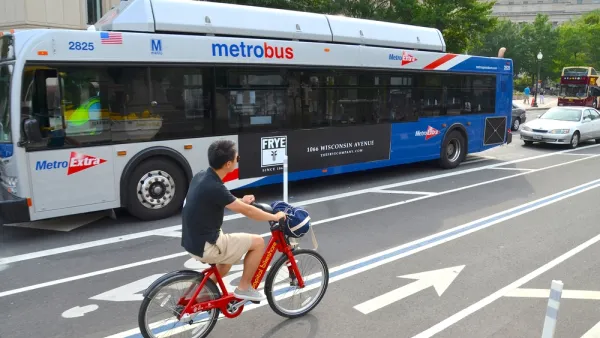
In D.C., Employers Will Refund Workers Who Leave the Car at Home
D.C. has passed a "parking cash-out" law that goes further than a few preexisting examples to reward commuters who leave their cars at home.
ITDP's New On-Street Parking Pricing Guidebook
This report explores strategies for efficient and equitable parking management with an emphasis on pricing. These strategies enable cities to reallocate space for bus lanes, bicycle lanes, wider sidewalks, and pickup zones, and generate revenue.

Planetizen Federal Action Tracker
A weekly monitor of how Trump’s orders and actions are impacting planners and planning in America.

Chicago breaks ground on $3 billion megadevelopment
The new neighborhood, titled Foundry Park, will one day host 3,700 residences.

Denver is solving homelessness. Why aren't the rest of us?
Since 2023, Denver's street homeless population has decreased by 64%, proving that effective tools exist to support those in need of housing.

LA accused of breaching $1.4 billion sidewalk repair settlement
The city faces a backlog of nearly 5,000 street repair requests.

MTA kicks off six-year, $1 billion transit upgrade project
The authority is replacing the roughly 90-year-old train signals on the A and C line with modern technology.

Developers may expand largest gas pipeline network in Northwest
Pipeline giant Williams has proposed new expansions for its Northwest Pipeline from the Colorado Rockies through Idaho, Oregon and Washington.

FREE Course: Walkable City 1: Why Walkability?
After describing his path towards focusing on walkability as the essence of good planning, Jeff Speck marches through his five principal reasons for making more walkable places.
Reinventing Malls: Planning Alchemy—Turning Gray Fields Into Gold
The course focuses on the opportunities and imperatives that shape reinvention of mall sites.

City of Rosemead
Rutgers University, Edward J. Bloustein School of Planning and Public Policy
One Hundred Miles
The Architects Foundation
University of Cincinnati Online
Montrose County
Northern Illinois Transit Authority (NITA)
The Pocatello Development Authority