A proposed ‘tiny home village’ meant to serve as temporary housing for unhoused residents has yet to break ground more than a year after it was announced.



“More than 15 months after Salt Lake City’s mayor announced a planned tiny home village for the homeless, construction has yet to begin,” reports Daniel Woodruff for KUTV.
Originally slated to begin construction last year, the groundbreaking on the Other Side Village project has not taken place. According to Tim Stay, CEO of the project, the delays were caused by environmental studies and cleanup and bureaucratic hurdles for the unique development. “The project is set to be built in phases. Stay said the first phase will include about 60 tiny homes along with a medical and mental health treatment facility. Ultimately, plans call for more than 430 tiny houses to be built across the property.”
Notably, “the Salt Lake City Council will ultimately get to decide whether to rezone the property for the tiny home village and lease the Indiana Avenue property to the village operators at a discounted rate.”
Read the full story: Construction yet to begin on tiny home village for Salt Lake's homeless population
Atlanta Approves Funding for 500 ‘Micro’ Housing Units
The city is promoting quick-build, low-cost solutions to stem the homelessness crisis.
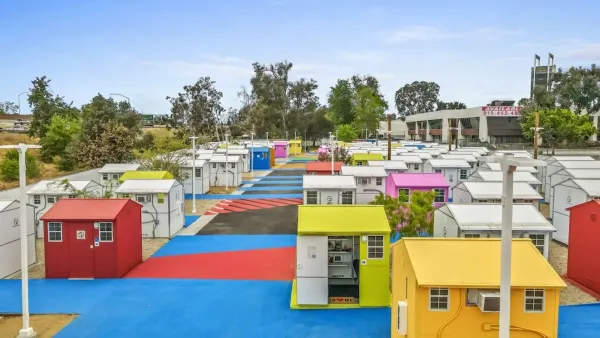
Tiny Homes are a First—but not Last—Step in Ending Homelessness
Cities are trying to stretch affordable housing funds to meet the demand for both short- and long-term housing.
California Pledges to Provide 1,200 ‘Tiny Homes’ for Unhoused Residents
Critics of the plan say the effort is a drop in the bucket in a state where tens of thousands of people experience homelessness every night.

Planetizen Federal Action Tracker
A weekly monitor of how Trump’s orders and actions are impacting planners and planning in America.

California plans to bury El Niño’s downpour
If the state plays its cards right, it may be able to store a billion acre-feet of El Niño’s water in aquifers.

Desperate measures: Advocates weigh draining Lake Powell to fill Colorado River
Draining the reservoir could reduce evaporation losses by a couple hundred thousand acre-feet.

Chicago voters approve permanent festival grounds, penalty for vacant property owners
Currently, major summer and fall festivals take over public parks for weeks at a time, drawing criticism from nearby residents

NYC votes to cut outdoor dining red tape, speed up permitting
New York City also voted to allow the Department of Transportation to begin work on urgent projects before notifying elected officials.

California appears to reject Prop. 45
The proposition would have expanded the projects that qualify for a streamlined environmental review, effectively paring down the California Environmental Quality Act.

FREE Course: Walkable City 1: Why Walkability?
After describing his path towards focusing on walkability as the essence of good planning, Jeff Speck marches through his five principal reasons for making more walkable places.
Reinventing Malls: Planning Alchemy—Turning Gray Fields Into Gold
The course focuses on the opportunities and imperatives that shape reinvention of mall sites.


City of Rosemead
Rutgers University, Edward J. Bloustein School of Planning and Public Policy
One Hundred Miles
Hunter College, City University of New York (CUNY)
The Architects Foundation
University of Cincinnati Online
City of Cambridge
Montrose County
The Pocatello Development Authority