After homeowners received letters assessing their property’s fire risk, questions remain about the next steps in building fire resilience.


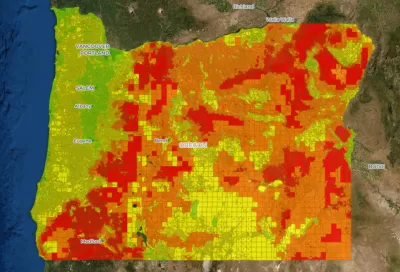
A new wildfire risk map has drawn questions from Oregon homeowners, reports Tiffany Olin for KTVL. Olin writes, “people across Southern Oregon have received letters in the mail from the Department of Forestry classifying their property as high or extreme risk and within the wildland-urban interface.” But the letters have raised questions since they don’t indicate how homeowners should respond. Derek Gasperini, Public Affairs Officer for Oregon Department of Forestry (ODF), said for now, homeowners just need to be aware of the risk to their home.
According to the article, “The Oregon State Fire Marshal will be passing defensible space codes and other regulations by December of this year that are expected to go into effect by April of 2023.” Gasperini said grants will be available to help homeowners pay for defensible space upgrades, which will be required as part of Senate Bill 762, “passed as a response to the 2020 Labor Day fires across the state.”
Planetizen recently covered a proposal to build a community-wide fire perimeter in Paradise, California. The proposal is in part an acknowledgement that fire protection measures can be expensive or impractical for renters, mobile home owners, and other residents in diverse housing types.
Read the full story: Oregon's new wildfire risk map sparks questions among Southern Oregonians
Can We Know Which Homes in California Will Burn?
As the state's worst wildfire season ever refuses to end, an analyst from UCLA considers how land use and building codes determine the location and extent of the damage.
How the West Got Bigger, Badder Fires
Two new books chronicle the origin of U.S. policy on wildfire, the damage that policy has done, and why it’s unlikely to change any time soon.
Wildfires are coming for America’s suburbs
Buying land in between paved cities and forests has become increasingly popular, but those same areas are naturally fire prone.

Planetizen Federal Action Tracker
A weekly monitor of how Trump’s orders and actions are impacting planners and planning in America.

Washington state to charge fee to drivers with fuel-efficient cars
Revenue from the fee will go towards supporting the state’s highways.

Illinois considers spending $1 billion in taxpayer money on data center
A quantum computing campus and data center are currently under construction in Chicago.

Did data centers change how voters cast their ballots?
Texas, Ohio, and Georgia all flipped party control. But in rural counties, the effect of local data centers was mixed.

Amtrak invests in eight new Airo trainsets
The new trainsets will begin serving passengers in 2031.

HUD to end aid for mixed-immigration-status households
The new rule is projected to impact 80,000 people, nearly half of whom are children.

FREE Course: Walkable City 1: Why Walkability?
After describing his path towards focusing on walkability as the essence of good planning, Jeff Speck marches through his five principal reasons for making more walkable places.
Reinventing Malls: Planning Alchemy—Turning Gray Fields Into Gold
The course focuses on the opportunities and imperatives that shape reinvention of mall sites.

City of Charlotte
City of Rosemead
Rutgers University, Edward J. Bloustein School of Planning and Public Policy
University of Michigan School for Environment and Sustainability (SEAS)
Hunter College, City University of New York (CUNY)
The Architects Foundation
University District Partnership