Auburn, Maine, a city of 20,000 residents, has plans to add enough housing to increase its population by 25 percent by 2025.



Daniel M. Rothschild reports for Discourse Magazine about Auburn, Maine, as the “YIMBYest City in America.” The city’s pro-development efforts are the work of Mayor Jason Levesque, who is pursuing a development strategy for Auburn “that eschews the current fashions of urban planning, undertaking instead a quest to increase the city’s population by a quarter or more in the coming years by unleashing the private sector to build 2,000 new housing units by 2025,” writes Rothschild.
“To put it in perspective, it would be like New York City adding 800,000 new homes and more than 2 million new residents.”
According to Mayor Levesque, Auburn has plenty of jobs, but it lacks housing. Auburn, like much of the rest of the nation and the state is dealing with skyrocketing housing prices.
“Supply isn’t keeping up with demand. As in many other parts of the country, prices are up astronomically: The cost of the median single-family home in the state has increased almost 40% over the past two years, due in part to a pandemic-fueled in-migration rate that is one of the highest in the country per capita,” writes Rothschild.
Mayor Levesque has pursued a series of reforming, starting with a new comprehensive plan approved in December 2021, to “[clear] away barriers to building new housing in Auburn, adopting an ‘all of the above approach’ that includes single-family homes, multi-family homes, apartments and accessory dwelling units (or ADUs). And truly, all options are on the table: a former synagogue was recently converted into 10 apartments.”
The comprehensive plan, according to Mercatus Center economist Salim Furth, goes beyond the example of Minneapolis and Oregon in allowing new investment in established neighborhoods.
After introducing the setting and the players in this story, the article digs into the specifics of the zoning code update that will implement the vision laid out in the city’s new comprehensive plan. The zoning changes are not without controversy, despite Mayor Levesque's leadership on the issues.
“Perhaps the most contentious issue facing the city—and one that really brings out Levesque’s blue-collar populism—is the Agriculture and Resource Protection Zone,” which accounts for about 40 percent of the city’s land area, according to the article. The source article below details Levesque’s response to local residents opposing reforms to the Ag Zone.
See also, previous coverage of Auburn's plan implementation process from March 2022: "Auburn, Maine Approves New Residential and Commercial Densities Despite Public Outcry."
Read the full story: The YIMBYest City in America

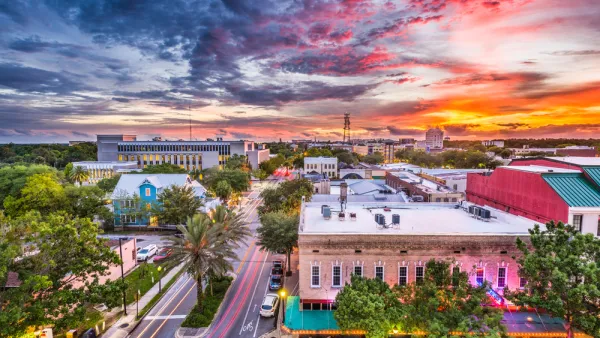
Gainesville Eliminates Single-Family Zoning
Gainesville is the first city in Florida to eliminate exclusionary zoning.

Auburn, Maine Approves New Residential and Commercial Densities Despite Public Outcry
Auburn, Maine offers the latest an example of a small city deciding to increase its capacity for future development in response to housing pressure, even in the face of intense public opposition.

Fourplexes on the Legislative Agenda in San Francisco
San Francisco, the poster child for runaway housing costs and displacement of existing residential populations, could be on the cusp of a change of plans.

Planetizen Federal Action Tracker
A weekly monitor of how Trump’s orders and actions are impacting planners and planning in America.

The state-sanctioned urbicide of Austin
People don’t kill cities. Freeways do.

Colorado’s Largest Data Center Could Rise Next to Homes — Without a Public Hearing
The proposed campus would consume 11 times the power of Denver International Airport; as it has across the country, opposition mounts.

Judges permit Denver to divert 77,000 acre feet from the Colorado River for reservoir expansion
Overuse and climate change have caused the Colorado River’s water levels to plummet.

Amtrak, CN end decades-long dispute with eight-year agreement
The new operating agreement establishes an updated framework for the companies to work together, including processes to resolve disputes.

Raised interest rates may kill financially vulnerable construction projects
The chief economist at ConstructConnect warns that if construction project owners are negatively impacted by the raised rates, it could result in delayed payments to contractors.

FREE Course: Walkable City 1: Why Walkability?
After describing his path towards focusing on walkability as the essence of good planning, Jeff Speck marches through his five principal reasons for making more walkable places.
Reinventing Malls: Planning Alchemy—Turning Gray Fields Into Gold
The course focuses on the opportunities and imperatives that shape reinvention of mall sites.

KFH Group Inc.
Greater Baltimore Committee
Eagle County Government
The Architects Foundation
University of Cincinnati Online
The Pocatello Development Authority
The Urban Renewal Agency of the City of Pocatello