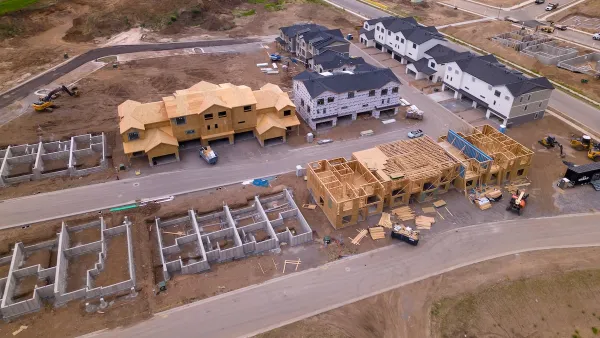
The country of New Zealand could take the drastic step of implementing planning reforms that allow more dense residential developments throughout the country.



New Zealand lawmakers will consider a pair of proposed laws that that will allow more dense housing options around the country.
"New intensification rules will allow buildings of up to three storeys on most sites in cities without any need for resource consent from August 2022," reports Henry Cooke of the recently unveiled bill. Consent will also not be required to build on up to 50 percent of properties.
"The bill is paired with a speed-up of the Government’s National Policy Statement on Urban Development (NPS-UD), which stops councils hindering development by banning height limits of less than six storeys and car parking requirements in urban areas," adds Cooke. The NPS-UD will now take effect in August 2023.
"Analysis from PWC suggests these changes will add between 48,200 and 105,500 new dwellings over the next five to eight years," reports Cooke.
New Zealand officials announcing the proposed bill touted the benefits of urban density as a response to skyrocketing housing prices and claimed the law would provide new planning policy certainty to homeowners, councils, developers, and investors.
FULL STORY: Labour, National announce sweeping housing density law, three-storey homes without consent

‘Montana Miracle:’ The State Actually Succeeding at Housing Reform
A series of ambitious zoning reforms is having a significant impact on the state’s housing supply.

NYC Council Approves Brooklyn Rezoning Plan
The Atlantic Avenue Mixed Use Plan includes infrastructure investments and could bring 4,600 new housing units to parts of Brooklyn.

DC Residents Want Affordability Over ‘Character’
A poll finds that most residents want to see changes in zoning and land use laws that unlock more housing construction in the District and improve affordability.

Planetizen Federal Action Tracker
A weekly monitor of how Trump’s orders and actions are impacting planners and planning in America.

The state-sanctioned urbicide of Austin
People don’t kill cities. Freeways do.

US to reduce Colorado River water deliveries to Mexico
A new Colorado Treaty amendment reduces Mexico’s Colorado River water allocation by 250,000 acre feet.

Baltimore to break ground on $50 million Transit Priority Project
The project will bring faster bus trips, safer streets and better bike connections to Baltimore.

Airbnb launches $250 million 'last-dollar financing' housing accelerator, makes first investment in Austin
The company will put $6.4 million towards affordable housing development in Texas’ capital.

Guerilla urbanists are building DIY bus stop benches in Chicago
A before-and-after of one of the bus stops with a new bench. The new benches are not officially sanctioned or permitted, but the residents who placed them hope they will be the start of a network of DIY benches across the city.

FREE Course: Walkable City 1: Why Walkability?
After describing his path towards focusing on walkability as the essence of good planning, Jeff Speck marches through his five principal reasons for making more walkable places.
Reinventing Malls: Planning Alchemy—Turning Gray Fields Into Gold
The course focuses on the opportunities and imperatives that shape reinvention of mall sites.

Eagle County Government
Harvard University Graduate School of Design
Nashville Planning Department
The Architects Foundation
University of Cincinnati Online
The Pocatello Development Authority
The Urban Renewal Agency of the City of Pocatello
Journal of the American Planning Association