The bill's more than 400 amendments include a VMT pilot, a Texas megahighway, and funding for accessibility at transit stations.


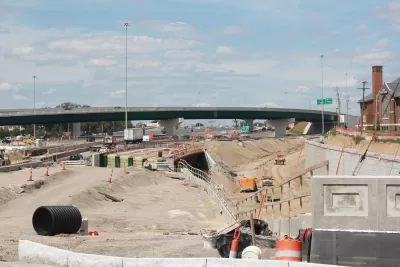
Kea Wilson highlights key points of some of the amendments proposed for the revised infrastructure bill, including a proposal to supplement or replace the gas tax as more Americans purchase electric vehicles. "One option that’s gained bipartisan interest in recent years is a Vehicle Miles Travelled tax (also known as a mileage-based user fee). The bill includes $50 million for a five-year pilot to study how the U.S. might shift to the innovative model, as well as to raise public awareness about its benefits (though some argue it’s not a silver bullet, or that drivers should face other taxes, too.)"
"One of the handful of amendments that the Senate did manage to pass on Tuesday — and with landslide bipartisan support to boot — was aimed at understanding just how the Highway Trust Fund became so drastically underfunded." Transit advocates hope that "commissioning the first federal study that actually quantifies that blindingly obvious truth is an important first step towards finding a funding mechanism that actually reflects the full costs of the mode."
"The visionary All Stations Accessibility Program Act (which Streetsblog discussed with sponsor Sen. Tammy Duckworth (D-Ill.) in May) gained a much-deserved place in the bill, with $1.75-billion devoted to helping transit agencies and commuter rail providers retrofit stations to meet the needs of people with physical, cognitive, sensory, and other mobility challenges." But that falls short of the $10 billion originally requested by the senator, and an amendment calling for "equity of service to all riders…taking into account historical and current service gaps" failed to pass.
"As the debate slogs on, advocates are still doing everything they can to fold the best provisions of the House’s celebrated INVEST Act into the Senate’s largely status-quo reauthorization measures — something that could be especially critical if the mega-bill isn’t conferenced in the House like pretty much everyone wants. "
Read the full story: Advocates Find More Surprises in Bipartisan Infrastructure Bill, Amendments
A State-by-State Wish List for Federal Infrastructure Funding
States have a laundry list of major projects they'd like to see funded if the trillion-dollar infrastructure package passes.
Op-Ed: Instead of a New VMT Tax, Raise the Gas Tax
Implementing a tax based on miles traveled could disincentivize purchasing more efficient cars and would do little to improve road safety, one columnist argues.
Can State Lawmakers Make the Case for Road Charges?
More state legislatures are considering fees based on vehicle miles traveled as a replacement for declining gas tax revenues.

Planetizen Federal Action Tracker
A weekly monitor of how Trump’s orders and actions are impacting planners and planning in America.

California plans to bury El Niño’s downpour
If the state plays its cards right, it may be able to store a billion acre-feet of El Niño’s water in aquifers.

Desperate measures: Advocates weigh draining Lake Powell to fill Colorado River
Draining the reservoir could reduce evaporation losses by a couple hundred thousand acre-feet.

Chicago voters approve permanent festival grounds, penalty for vacant property owners
Currently, major summer and fall festivals take over public parks for weeks at a time, drawing criticism from nearby residents

NYC votes to cut outdoor dining red tape, speed up permitting
New York City also voted to allow the Department of Transportation to begin work on urgent projects before notifying elected officials.

California appears to reject Prop. 45
The proposition would have expanded the projects that qualify for a streamlined environmental review, effectively paring down the California Environmental Quality Act.

FREE Course: Walkable City 1: Why Walkability?
After describing his path towards focusing on walkability as the essence of good planning, Jeff Speck marches through his five principal reasons for making more walkable places.
Reinventing Malls: Planning Alchemy—Turning Gray Fields Into Gold
The course focuses on the opportunities and imperatives that shape reinvention of mall sites.

City of Rosemead
Rutgers University, Edward J. Bloustein School of Planning and Public Policy
One Hundred Miles
Hunter College, City University of New York (CUNY)
The Architects Foundation
University of Cincinnati Online
City of Cambridge
Montrose County
The Pocatello Development Authority