Los Angeles County implements equity-focused community parks and recreation plans.



What is a plan’s worth? How should the value of a plan be determined? Should a plan be judged by the degree to which it is implemented? What good is a plan if it offers a vision that is unfulfilled? These are the types of questions that many planners may have wrestled with during their careers.
In this Parks & Recreation magazine article, park planner Clement Lau explains how the Los Angeles County Department of Parks and Recreation (DPR) plans with equity and implementation in mind, ensuring that its plans prioritize the neediest communities and do not end up just sitting on bookshelves. Examples of such planning documents include the Los Angeles Countywide Parks and Recreation Needs Assessment, Community Parks and Recreation Plans (CPRPs), and the Earvin “Magic” Johnson Park Master Plan. The article focuses on the implementation of the CPRPs which is well under way, with a multitude of projects at varying scales and stages of development.
Lau was also interviewed by the National Recreation and Park Association's Open Space Radio. In addition to discussing this article, Lau explains his passion for planning and how he got interested in the field. To listen, please visit this link.
Read the full story: From Plans to Parks


Adopting an Intersectional Approach to Parks Planning
This approach makes sense because parks are not isolated spaces, and park planning cannot be done effectively or holistically without considering the social, economic, physical, and political context in which parks are located.
Park Planning in a Pandemic
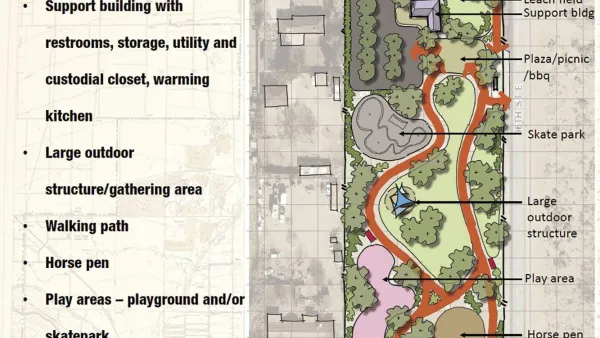
In pursuit of a grant for park development, Los Angeles County engages community members virtually to gather input and design a new park.

Creativity Needed to Meet Recreational Needs During a Pandemic
With COVID-19, the Los Angeles County Department of Parks and Recreation modified its popular Parks After Dark program so that it could still meet community needs, while complying with public health orders.

Planetizen Federal Action Tracker
A weekly monitor of how Trump’s orders and actions are impacting planners and planning in America.

Northwest rail fans eager for Sept. 30 debut of Amtrak’s Airo fleet
Get ready for that new train smell and more seats. But they won’t go faster or run more frequently on the Cascades route in Washington and Oregon.

Record-breaking wildlife overpass in Colorado brings 91% reduction in animal collisions
Prior to the overpass, vehicles were hitting one deer per day on Colorado’s Interstate 25.

Detroit to transform waterfront with $2.2 billion investment
Developers will convert about 18 acres of unused parking lot space into civic spaces.

‘Going backwards:’ Baltimore mayor, students rally against state's transit funding plan
Maryland's proposed six-year plan provides no funding for Baltimore’s BMORE bus program and reduces its road maintenance funding.

Trump wants to cancel nearly 98% of funding for HUD housing support program
Multiple housing groups are suing the administration in an effort to preserve the funding.

FREE Course: Walkable City 1: Why Walkability?
After describing his path towards focusing on walkability as the essence of good planning, Jeff Speck marches through his five principal reasons for making more walkable places.
Reinventing Malls: Planning Alchemy—Turning Gray Fields Into Gold
The course focuses on the opportunities and imperatives that shape reinvention of mall sites.

City of Thousand Oaks
City of Wisconsin Rapids
Harvard University Graduate School of Design
The Architects Foundation
University of Cincinnati Online
Northern Illinois Transit Authority (NITA)
The Pocatello Development Authority
The Urban Renewal Agency of the City of Pocatello