A critical economic bellwether is showing tentative signs of recovery.



The American Institute of Architects' latest Architecture Billings Index shows a slight improvement in business conditions, although work is still slowing. The report is considered a bellwether for built environment professions, including planning, as well as the larger economy.
An article published by Building Enclosure provides insight into the report's findings, which updates data through the first month of 2021: "AIA’s Architecture Billings Index (ABI) score for January was 44.9* compared to 42.3 in December (any score below 50 indicates a decline in firm billings). Last month’s score indicates overall revenue at U.S architecture firms continued to decline from December to January, however, the pace of decline slowed."
The AIA's Architecture Billings Index breaks down the financial data by region. By geography, the South is performing best, relative to other regions, with an index of 47.4. The worst performing, the Northeast, had an index of 41.9 in January 2021.
Checking in with the ABI throughout the past year, Planetizen noted the state of the ABI as important junctures of the pandemic economic downturn, including a strong sector just previous to the shutdowns and economic downturn in Spring 2020, the eventual collapse of business as the pandemic lingered, and the first signs of a potential recovery in the fall of 2020.
Read the full story: Architectural Billings Continue to Contract in 2021

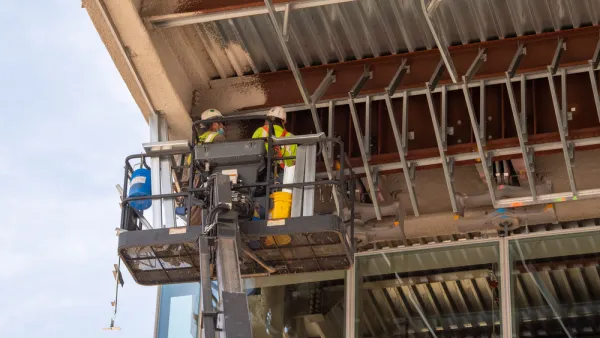
Architecture Billings Show a Modest Rebound
Many architecture firms are still struggling, but the industry, a bellwether for planning and the larger economy, has recovered a little from the lows of the spring and summer months.

Haves and Have Nots: Planning and the Deep Divides of the Pandemic
The latest in a series of compendia gathering news and analysis about the effects of the COVID-19 on the built and natural environments—now and long into the future.
COVID Stimulus Details for Planners
A few last minute changes were included in the version of the COVID-19 Emergency Relief Act of 2020, approved by Congress last night.

Planetizen Federal Action Tracker
A weekly monitor of how Trump’s orders and actions are impacting planners and planning in America.

The state-sanctioned urbicide of Austin
People don’t kill cities. Freeways do.

US to reduce Colorado River water deliveries to Mexico
A new Colorado Treaty amendment reduces Mexico’s Colorado River water allocation by 250,000 acre feet.

Nation's most wind-powered state turns to coal as data centers increase energy demand
For the first time in decades, Iowa has increased its generation of coal power.

NYC cools commuters with city's first rain garden above a bus stop
New York City officials say the plants in the rain garden can absorb 16 gallons of rainwater during heavy storms.

Brightline West’s future may rely on $6 billion federal loan
The company has until Nov. 2 to make a $400 million equity investment into its proposed high-speed rail line.

FREE Course: Walkable City 1: Why Walkability?
After describing his path towards focusing on walkability as the essence of good planning, Jeff Speck marches through his five principal reasons for making more walkable places.
Reinventing Malls: Planning Alchemy—Turning Gray Fields Into Gold
The course focuses on the opportunities and imperatives that shape reinvention of mall sites.

Greater Baltimore Committee
Eagle County Government
Harvard University Graduate School of Design
The Architects Foundation
University of Cincinnati Online
The Pocatello Development Authority
The Urban Renewal Agency of the City of Pocatello
Journal of the American Planning Association