Some of the world's biggest companies are investing in affordable housing, hoping to stymie the growing crisis their growth has contributed to.


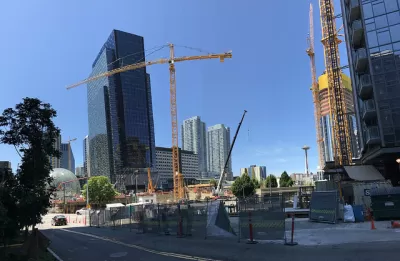
Amazon's newly launched Housing Equity Fund promises to build and preserve more than 20,000 housing units near the company's three U.S. hubs with a $2 billion investment. The program includes below-market grants and loans to "public agencies, housing partners and minority-led groups," according to Cailin Crowe.
Amazon expects the workforce at these three locations to reach around 5,000 employees in the next few years and calls the housing initiative an effort to "be part of the solution" to the housing affordability crisis facing many of their employees and other residents in surrounding communities. "Tech giants like Amazon have made a number of affordable housing investments in recent years, a problem many experts have said such companies helped create," writes Crowe. Apple, Microsoft, Google, and Facebook have all made billion-dollar commitments ($2.5 billion in Apple's case) to investing in affordable housing.
Experts like Sarah Rosen Wartell, president of the Urban Institute, laud the companies' efforts to support affordable housing, noting that the move also signals to local elected leaders that "investment in affordable housing is a critical, necessary step for a region's balanced, healthy economy." King County Councilmember Jeanne Kohl-Welles expressed appreciation for the pledges, but acknowledged there's a long way to go. "This investment is a relative drop in the bucket, but Amazon’s loans and grants will provide much needed capital for expanding our supply of affordable housing now, when our communities need it the most."
Read the full story: Amazon commits $2B to housing equity

Calthorpe Makes the Case for a Corridor-Based Approach to Affordable Housing
Peter Calthorpe's case study of El Camino Real in the Silicon Valley shows the potential for affordable housing development in the land surrounding side right-of-ways.
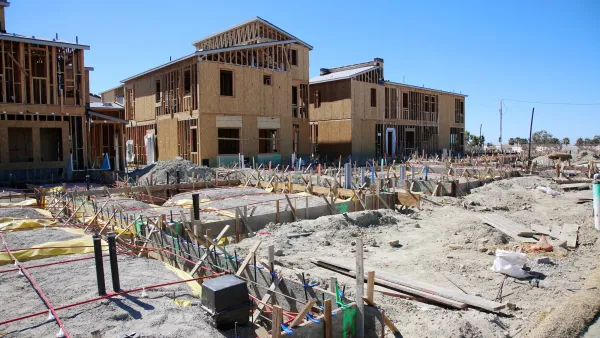
Less than 6% of California cities are building enough housing for very low-income households
Only five jurisdictions are on track to meet their housing goals for all income brackets.
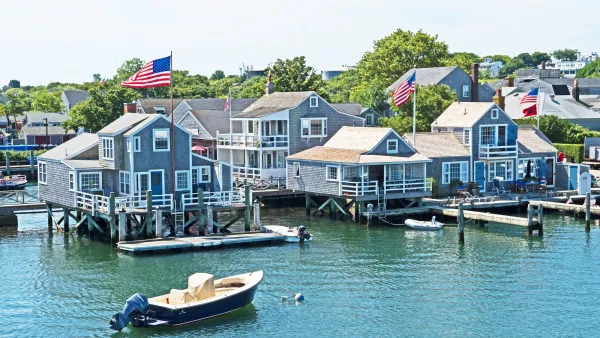
In Nantucket, where over half of homes are for seasonal use, workers struggle to find affordable housing
The island is short roughly 892 to 1,081 rental units.

Planetizen Federal Action Tracker
A weekly monitor of how Trump’s orders and actions are impacting planners and planning in America.

Eastern Nebraska is running out of electricity
Data centers and electrification are straining eastern Nebraska’s grid, throttling economic development.

Study reveals best places in the U.S. for cycling, walking
New research from Streetlight Data examines bicycle and pedestrian miles per capita in the 100 largest U.S. cities by population.

Developers reveal $10 billion stadium plan as ‘Hail Mary’ to keep Bears in Chicago
The plan would also boast a public park, high- and mid-rise buildings and a youth sports complex.

As Texas embraces carbon storage, a Black community questions the risks
Texas now issues permits for companies to store carbon dioxide underground. East Texas residents fear safety risks, and skeptics doubt the climate benefits.

New BLM proposal would slash public comment periods, environmental protections
The proposed rewrite would also strip legal leverage from Tribal nations and state governments.

FREE Course: Walkable City 1: Why Walkability?
After describing his path towards focusing on walkability as the essence of good planning, Jeff Speck marches through his five principal reasons for making more walkable places.
Reinventing Malls: Planning Alchemy—Turning Gray Fields Into Gold
The course focuses on the opportunities and imperatives that shape reinvention of mall sites.

City of Rosemead
Rutgers University, Edward J. Bloustein School of Planning and Public Policy
One Hundred Miles
University of Michigan School for Environment and Sustainability (SEAS)
Hunter College, City University of New York (CUNY)
The Architects Foundation
City of Cambridge
The Pocatello Development Authority
The Urban Renewal Agency of the City of Pocatello