The pandemic didn't help, but this moment has been a long time coming, and the delay is bad news for President Trump efforts to exclude undocumented immigrants from the count.



"The Census Bureau will reportedly miss its end-of-year deadline for the first time since the Dec. 31 date was set by Congress 40 years ago," reports Joseph Choi, building on previous reporting by the Associated Press.
The article frames the missed deadline in terms of the consequences for President Trump's efforts to exclude undocumented immigrants from the count. Now that the data won't be presented until after the inauguration, President-elect Biden "will have the ability to rescind Trump's directive that excluded people in the country without authorization from being considered when the number of congressional seats for states are being divvied up," according to Choi.
The deadline comes and goes without penalty, and it's never been a problem before. Margo Anderson, a historian with the University of Wisconsin-Milwaukee is quoted in the article suggesting that the pandemic "and the Trump administration flip-flopping on its goals and its efforts to take the undocumented out of the apportionment count," might have contributed to the delay this year.
Planetizen documented the pandemic's impact on the decennial Census throughout the year, in addition to reports leading up the 2020 Census of dysfunction and controversy at the Census Bureau and the Department of Commerce since the Trump administration took office.
FULL STORY: Census Bureau to miss deadline for first time: report


Prepping for Today's Big 2020 Census Release
Setting the table as the nation awaits the first results from the 2020 Census.
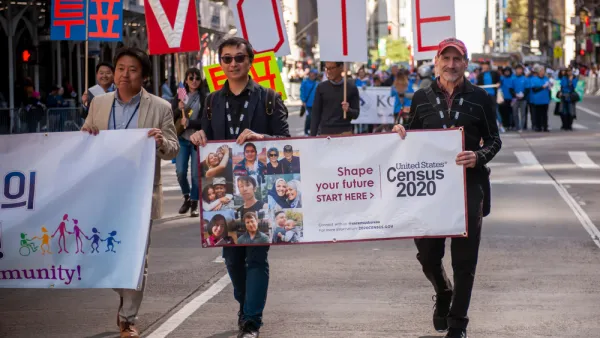
Another Delay for the Census: Now Expected for September Delivery
The pandemic and political mismanagement are continuing to have an effect on the 2020 Census.

More Bad News From the U.S. Census: Economic Census Delayed Six Months
A budget shortfall for Census 2020 has already claimed one victim: the timely delivery of the five-year Economic Census.

The state-sanctioned urbicide of Austin
People don’t kill cities. Freeways do.

US to reduce Colorado River water deliveries to Mexico
A new Colorado Treaty amendment reduces Mexico’s Colorado River water allocation by 250,000 acre feet.

New Jersey’s second-largest city bans standalone data centers
Jersey City will continue to allow co-location facilities, such as those meant for research institutions that store their own data.

Amtrak not solely to blame for New Jersey commuter rail's unreliability, report finds
A new study from the Garden State Initiative found that NJ Transit’s budget grew 20% across a 4 year period, but reliability declined significantly over the same period.

EPA erases limits on planet-warming pollution from power plants
Under Monday’s plan, power plants would still have some limits on how much mercury, arsenic and other contaminants they can emit.

Phoenix announces new on-demand transit service, more frequent RAPID buses
Both new services will launch in October, and are part of Phoenix's Project Effective Access Solutions for Easing Congestion.

FREE Course: Walkable City 1: Why Walkability?
After describing his path towards focusing on walkability as the essence of good planning, Jeff Speck marches through his five principal reasons for making more walkable places.
Reinventing Malls: Planning Alchemy—Turning Gray Fields Into Gold
The course focuses on the opportunities and imperatives that shape reinvention of mall sites.


Eagle County Government
Harvard University Graduate School of Design
Nashville Planning Department
The Architects Foundation
University of Cincinnati Online
The Pocatello Development Authority
The Urban Renewal Agency of the City of Pocatello
Journal of the American Planning Association