Downtown Indianapolis bus stops are getting a makeover with enhancements that prioritize buses and improve rider safety.


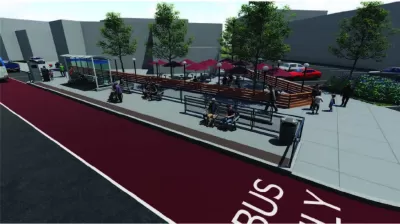
IndyGo, Indianapolis's transit agency, will build several enhanced bus stops as part of a partnership with the Indianapolis Department of Public Works. Dubbed "Super Stops," the new bus stops will feature shelter, a raised platform for improved access and visibility, information screens, and ticketing machines. The 90-foot long, elevated boarding platforms will accommodate more riders and make it easier to enter and exit buses. The changes will affect some of the city's busiest bus stops and serve as a model for future improvements.
The first two stops will be built as part of the reconstruction of Delaware Street, which will also create a bus-and-turn lane and install a new two-way segment on Fort Wayne Avenue to make turns easier for buses traveling down Delaware. "That lane of Delaware Street has buses in it so often that it essentially acts as a de facto bus lane already," Austin Gibble of IndyGo told the Indianapolis Star. The agency hopes that officially designating the lane for buses, along with other tweaks, will reduce travel time and increase reliability for riders. The new electronic ticketing system, once up and running, will reduce the need for cash payments and offer a free digital transit card (physical cards cost $2).
The first two stops begin construction in early 2021, and the city plans to install six more Super Stops in high-traffic downtown areas.
Read the full story: Improved bus stops are coming to downtown Indianapolis. Here's how to learn more.
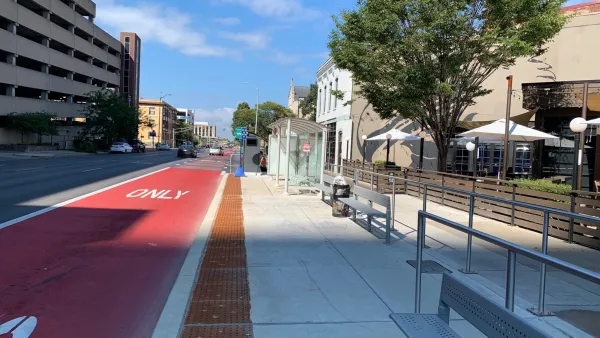
IndyGo Opens First ‘Super Stop’
The city plans to build eight enhanced bus stops that streamline boarding and offer seating, shelter, and ticketing machines.

State Bill Could Kill Indy BRT Line
A law proposed in the Indiana state legislature would ban dedicated bus lanes and force IndyGo to cancel a planned bus rapid transit line to the city's airport.
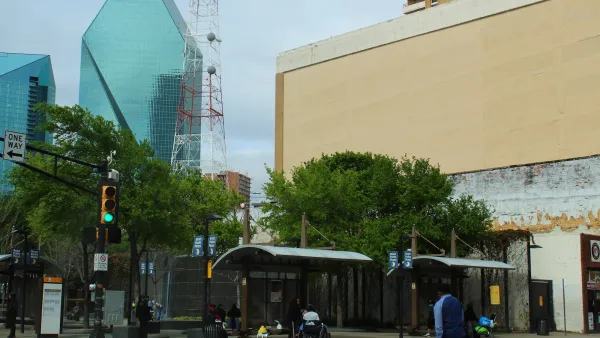
Dallas transit to invest up to $71.5M in upgraded bus shelters
The new shelters will feature solar-powered lighting and materials designed to protect riders from extreme weather.

Planetizen Federal Action Tracker
A weekly monitor of how Trump’s orders and actions are impacting planners and planning in America.

California plans to bury El Niño’s downpour
If the state plays its cards right, it may be able to store a billion acre-feet of El Niño’s water in aquifers.

Desperate measures: Advocates weigh draining Lake Powell to fill Colorado River
Draining the reservoir could reduce evaporation losses by a couple hundred thousand acre-feet.

Mamdani’s pied-à-terre tax survives legal challenge
A panel of judges found that the plaintiffs failed to demonstrate injury as a result of New York City's implementation of the tax.

Eastern Nebraska is running out of electricity
Data centers and electrification are straining eastern Nebraska’s grid, throttling economic development.

Seattle passes record-breaking transit services expansion
Proposition 1 will double the city’s transit tax to add 95,000 more bus trips and preserve 180,000 bus trips annually.

FREE Course: Walkable City 1: Why Walkability?
After describing his path towards focusing on walkability as the essence of good planning, Jeff Speck marches through his five principal reasons for making more walkable places.
Reinventing Malls: Planning Alchemy—Turning Gray Fields Into Gold
The course focuses on the opportunities and imperatives that shape reinvention of mall sites.


City of Rosemead
Rutgers University, Edward J. Bloustein School of Planning and Public Policy
One Hundred Miles
University of Michigan School for Environment and Sustainability (SEAS)
Hunter College, City University of New York (CUNY)
The Architects Foundation
City of Cambridge
Montrose County
The Pocatello Development Authority