The new skyscraper being built at 200 Amsterdam Avenue in Manhattan might be forced by an appeals court to remove 20 floors of the mostly complete building.


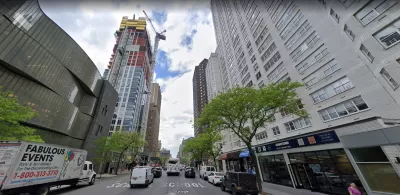
"Now that the 52-story tower at 200 Amsterdam Avenue is almost done, it may soon have to be partly undone, like a construction film running in reverse," writes Justin Davidson.
The building's final height is subject to a case currently underway in appeals court, with as many as 20 stories, already mostly built, hanging in the balance.
All of the confusion, according to Davidson, is thanks to New York's inscrutable zoning code, and the building's location on a "bizarre knot" of parcels.
Complexity favors developers equipped with expensive legal advice, which is how SJP Properties persuaded the Department of Buildings to issue a permit for a 668-foot spear sticking into the flank of the Upper West Side. The narrow, stretched-out tower designed by Elkus Manfredi reaches its kinda–sorta–neo–Art Deco–ish crown via a series of setbacks that make it look like a staircase in the wrong aspect ratio. Any tall building can unleash the usual It’s out of character! versus More housing now! shoutfest, but this one has turned area residents into self-appointed land-use experts.
As detailed in the history provided here by Davidson, the unbuilding of skyscrapers happens with some frequency in New York, and this wouldn't be the first time a building has had to lop its top off. That's where those with even a passing interest in the science and art of building might be interested in this case study. "In a city too packed for implosion or wrecking balls, disassembling an entire structure is slow and dangerous work, planned by specialized engineers," according to Davidson.
Read the full story: How Do You Chop 20 Stories Off a Too-Tall Building?


Judge Throws Out Plans for New Residential Skyscraper on Manhattan's Upper West Side
A residential skyscraper proposed for Manhattan's Upper West Side included a mechanical void that predated new rules in the city prohibiting the height-enhancing building practice. A judge still rejected the project as planned.

Manhattan Rezonings Pose Tough Challenges for Planners
The New York City Department of Planning kicked off a rezoning process for the Manhattan neighborhood of SoHo earlier this month. Planning and development challenges abound.

Lower Manhattan Climate Resilience Plan Released
The Financial District and Seaport Climate Resilience Master Plan will extend the shoreline in Lower Manhattan by up to 200 feet.

Planetizen Federal Action Tracker
A weekly monitor of how Trump’s orders and actions are impacting planners and planning in America.

The state-sanctioned urbicide of Austin
People don’t kill cities. Freeways do.

US to reduce Colorado River water deliveries to Mexico
A new Colorado Treaty amendment reduces Mexico’s Colorado River water allocation by 250,000 acre feet.

Nation's most wind-powered state turns to coal as data centers increase energy demand
For the first time in decades, Iowa has increased its generation of coal power.

NYC cools commuters with city's first rain garden above a bus stop
New York City officials say the plants in the rain garden can absorb 16 gallons of rainwater during heavy storms.

Brightline West’s future may rely on $6 billion federal loan
The company has until Nov. 2 to make a $400 million equity investment into its proposed high-speed rail line.

FREE Course: Walkable City 1: Why Walkability?
After describing his path towards focusing on walkability as the essence of good planning, Jeff Speck marches through his five principal reasons for making more walkable places.
Reinventing Malls: Planning Alchemy—Turning Gray Fields Into Gold
The course focuses on the opportunities and imperatives that shape reinvention of mall sites.

Eagle County Government
Harvard University Graduate School of Design
Nashville Planning Department
The Architects Foundation
University of Cincinnati Online
The Pocatello Development Authority
The Urban Renewal Agency of the City of Pocatello
Journal of the American Planning Association