The Trump administration has, in the past week before the election, achieved one of the largest rollbacks of public land protections of its entire tenure.


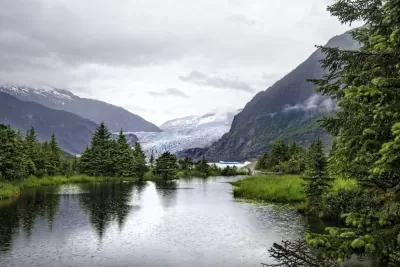
"President Trump will open up all 16.7 million acres of Alaska’s Tongass National Forest to logging and other forms of development," reports Juliet Eilperin.
The U.S. Department of Agriculture published the final rule and record of decision to the Federal Register on October 29, 2020.
The decision overturns protections in place for two decades for one of the world’s largest intact temperate rainforests.
On October 29, it became legal "for logging companies to build roads and cut and remove timber throughout more than 9.3 million acres of forest — featuring old-growth stands of red and yellow cedar, Sitka spruce and Western hemlock."
"The new rule states that it will make 'an additional 188,000 forested acres available for timber harvest,' mainly 'old growth timber,'" according to Eilperin.
According to the article, the national forest is considered an ecological oasis, home to immense ecological diversity and a massive carbon sink—absorbing "at least 8 percent of all the carbon stored in the entire Lower 48′s forests combined," according to Eilperin.
Supporters of the decision, including Gov. Mike Dunleavy and Sen. Dan Sullivan, pressed for the rule change in the hopes of jumpstarting an economy suffering the consequences of the pandemic. Southeast Alaska usually sees 1.4 million cruise passengers a year to fuel its tourism industry. That number has dropped to just 48 people this summer, according to the article. Still, the article reports widespread public disapproval of the decision.
FULL STORY: Trump to strip protections from Tongass National Forest, one of the biggest intact temperate rainforests

How the Trump Presidency Could Impact Urban Planning
An analysis of potential changes in federal housing, transportation, and climate policies.
Can the U.S. Preserve 30 Percent of its Lands and Waters?
The Biden administration released its preliminary report on a plan to conserve 30 percent of the nation's lands and waters by 2030, one big, ambitious component of the administration's climate plans.
President's Record on Conservation Criticized
President Trump has weakened protections for 35 million acres of public land, despite repeating his intentions to surpass the model for conservation set by President Teddy Roosevelt.

Planetizen Federal Action Tracker
A weekly monitor of how Trump’s orders and actions are impacting planners and planning in America.

The state-sanctioned urbicide of Austin
People don’t kill cities. Freeways do.

US to reduce Colorado River water deliveries to Mexico
A new Colorado Treaty amendment reduces Mexico’s Colorado River water allocation by 250,000 acre feet.

5 New England states march closer to 800 megawatt wind energy project
Securing federal approval for the project may be complicated under the Trump administration, which has historically been hostile towards domestic wind power.

Baltimore to break ground on $50 million Transit Priority Project
The project will bring faster bus trips, safer streets and better bike connections to Baltimore.

Airbnb launches $250 million 'last-dollar financing' housing accelerator, makes first investment in Austin
The company will put $6.4 million towards affordable housing development in Texas’ capital.

FREE Course: Walkable City 1: Why Walkability?
After describing his path towards focusing on walkability as the essence of good planning, Jeff Speck marches through his five principal reasons for making more walkable places.
Reinventing Malls: Planning Alchemy—Turning Gray Fields Into Gold
The course focuses on the opportunities and imperatives that shape reinvention of mall sites.

Eagle County Government
Harvard University Graduate School of Design
Nashville Planning Department
The Architects Foundation
University of Cincinnati Online
The Pocatello Development Authority
The Urban Renewal Agency of the City of Pocatello
Journal of the American Planning Association