President Trump has weakened protections for 35 million acres of public land, despite repeating his intentions to surpass the model for conservation set by President Teddy Roosevelt.


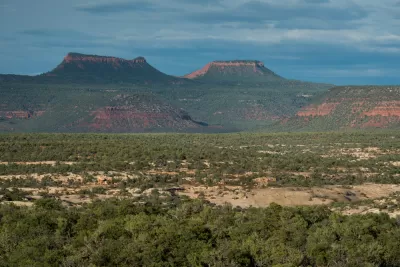
Throughout his time in office, surrogates for the president have proclaimed Trump's desire to surpass the model of Teddy Roosevelt for conservation, according to an article by Chris D’Angelo. Critics, however, say that the Trump administration has fallen far short of that example, and now there's data to back up that critique.
A new analysis from the Center for American Progress, detailed in a separate article by Jenny Rowland-Shea and Zainab Mirza says President Trump has, in fact, thrown the presidency's bipartisan history of expansion of public lands. "President Trump is the only president in U.S. history to have removed more public lands than he protected," according to that article.
The Center for American Progress calculates that over the past three years, the Trump administration has attempted to remove protections from nearly 35 million acres of public lands—approximately 1,000 times more land than his administration has protected. While the courts may overturn many of the Trump administration’s rollbacks, these actions equate to stripping protections from an area the size of Florida.
The article provides details of the scope of the Trump administration's anti-conservation efforts, all designed for the purpose, according to Rowland-She and Mirza, of giving the fossil fuel industry "unfettered access to public lands and waters."
FULL STORY: The Most Anti-Nature President in U.S. History

How the Trump Presidency Could Impact Urban Planning
An analysis of potential changes in federal housing, transportation, and climate policies.

How Project 2025 Could Threaten Public Lands
If enacted, the conservative plan could ‘decimate’ public lands and protected habitats.
Op-Ed: Feds 'Obsessed' with Undermining National Monument
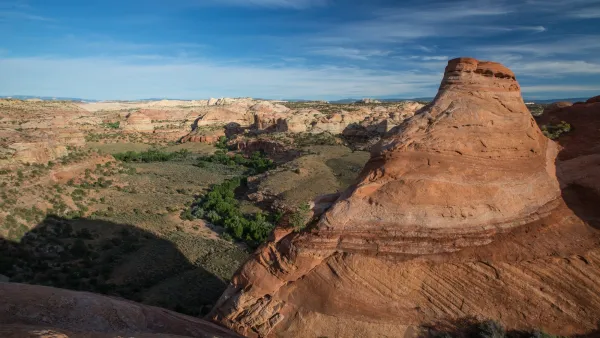
Utah's Grand Staircase-Escalante National Monument is under severe assault from the Trump administration, Stephen Trimble writes. Long the focus of preservation efforts, the protected land is being opened up for extractive uses.

The state-sanctioned urbicide of Austin
People don’t kill cities. Freeways do.

US to reduce Colorado River water deliveries to Mexico
A new Colorado Treaty amendment reduces Mexico’s Colorado River water allocation by 250,000 acre feet.

New Jersey’s second-largest city bans standalone data centers
Jersey City will continue to allow co-location facilities, such as those meant for research institutions that store their own data.

Amtrak not solely to blame for New Jersey commuter rail's unreliability, report finds
A new study from the Garden State Initiative found that NJ Transit’s budget grew 20% across a 4 year period, but reliability declined significantly over the same period.

EPA erases limits on planet-warming pollution from power plants
Under Monday’s plan, power plants would still have some limits on how much mercury, arsenic and other contaminants they can emit.

Phoenix announces new on-demand transit service, more frequent RAPID buses
Both new services will launch in October, and are part of Phoenix's Project Effective Access Solutions for Easing Congestion.

FREE Course: Walkable City 1: Why Walkability?
After describing his path towards focusing on walkability as the essence of good planning, Jeff Speck marches through his five principal reasons for making more walkable places.
Reinventing Malls: Planning Alchemy—Turning Gray Fields Into Gold
The course focuses on the opportunities and imperatives that shape reinvention of mall sites.

Eagle County Government
Harvard University Graduate School of Design
Nashville Planning Department
The Architects Foundation
University of Cincinnati Online
The Pocatello Development Authority
The Urban Renewal Agency of the City of Pocatello
Journal of the American Planning Association