The local councilmember is seeking a rezoning from commercial to residential in the Kensington neighborhood of Philadelphia, but local community members say the development will be priced out of their range.



Catalina Jaramillo reports from Philadelphia, where a proposal "to build 40 two-family rowhouses on vacant South Kensington lots and redevelop a former scrap yard into a luxury condo building has suffered a new setback."
"The proposal for the North American Street corridor is part of a set of two rezoning bills introduced by Councilmember María Quiñones-Sánchez in June. The second bill creates an overlay on the street between Oxford Street and Lehigh Avenue to allow residential use in what’s currently an industrial corridor designed to be a job center," explains Jamarrilo of the cause of an ongoing development controversy.
The proposal has run into opposition from long-time Black and Latino residents of the area, who argue that "they won’t be able to afford the housing promised by the projects, and that they will lose job opportunities and open space in the area."
That opposition led to a vote by the Philadelphia Planning Commission in August that only approved the portion of the project: "On Tuesday, commissioners approved the bill that would allow multi-family residential units on the N. American Street industrial corridor, but unanimously rejected the measure to use vacant lots currently in the hands of the Land Bank to create mixed-income housing and a condo in the former scrap yard."
As noted in the article, the Philadelphia Planning Commission serves an advisory role, like most planning commissions in the United States, so elected officials could yet ignore the commission's decision and proceed with the development and rezoning as proposed.
FULL STORY: City Planning Commission rejects plans for affordable housing on ‘very small lots’

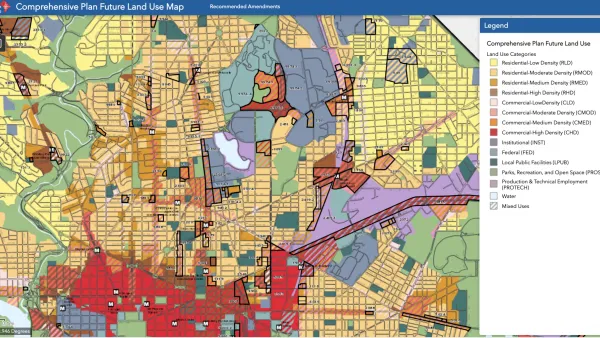
D.C. Comprehensive Plan Update Needs Equity Improvements, Report Says
The new D.C. Office of Equity has produced an evaluation of proposed changes to the D.C. Comprehensive Plan.

Is Anti-Growth the Wrong Approach to Fighting Gentrification?
Limiting development has been a powerful tool for anti-gentrification activists, but have these policies had counter-productive effects?

Judge Tosses Area Planning Commission Decision on Controversial South L.A. Project
The California Housing Accountability Act, approved by the State Legislature in 2017, is cited in a court ruling that soundly rebuffs the decision by the South Los Angeles Area Planning Commission to veto a controversial project.

The state-sanctioned urbicide of Austin
People don’t kill cities. Freeways do.

US to reduce Colorado River water deliveries to Mexico
A new Colorado Treaty amendment reduces Mexico’s Colorado River water allocation by 250,000 acre feet.

New Jersey’s second-largest city bans standalone data centers
Jersey City will continue to allow co-location facilities, such as those meant for research institutions that store their own data.

Amtrak not solely to blame for New Jersey commuter rail's unreliability, report finds
A new study from the Garden State Initiative found that NJ Transit’s budget grew 20% across a 4 year period, but reliability declined significantly over the same period.

EPA erases limits on planet-warming pollution from power plants
Under Monday’s plan, power plants would still have some limits on how much mercury, arsenic and other contaminants they can emit.

Phoenix announces new on-demand transit service, more frequent RAPID buses
Both new services will launch in October, and are part of Phoenix's Project Effective Access Solutions for Easing Congestion.

FREE Course: Walkable City 1: Why Walkability?
After describing his path towards focusing on walkability as the essence of good planning, Jeff Speck marches through his five principal reasons for making more walkable places.
Reinventing Malls: Planning Alchemy—Turning Gray Fields Into Gold
The course focuses on the opportunities and imperatives that shape reinvention of mall sites.

Eagle County Government
Harvard University Graduate School of Design
Nashville Planning Department
The Architects Foundation
University of Cincinnati Online
The Pocatello Development Authority
The Urban Renewal Agency of the City of Pocatello
Journal of the American Planning Association