Under new board president Rex Richardson, the Southern California Association of Governments—the country's largest MPO—has pledged to combat racism through regional planning, including equitable housing development.



"Systemic racism has a direct impact on the quality of life and health of the 19 million residents within the SCAG region. We have a responsibility to acknowledge that increasing economic segregation, the housing crisis, and the COVID-19 pandemic all have been exacerbated by race and inequality. As we put forward regional planning documents or long range plans, like our Sustainable Community Strategy, our Regional Transportation Plan and other activities that we may take on as an MPO, we have to do it moving forward with the lens of both public health and the lens of race."
"I think now's a moment where public servants and civil servants can't be neutral on this issue. We're all being called forward to do all that we can to address racism and inequity, and it should be considered a professional standard, not political. Some folks consider anything related to race as a political issue. As public employees, sometimes we're trained to shy away from those issues. We should create a culture and a workplace where it's our job to ensure that inequity is rooted out. We should make sure that it's moving into our policies and plans and our municipal codes."
FULL STORY: Q&A: SCAG President Rex Richardson Calls for Antiracist Regional Planning [paywall]

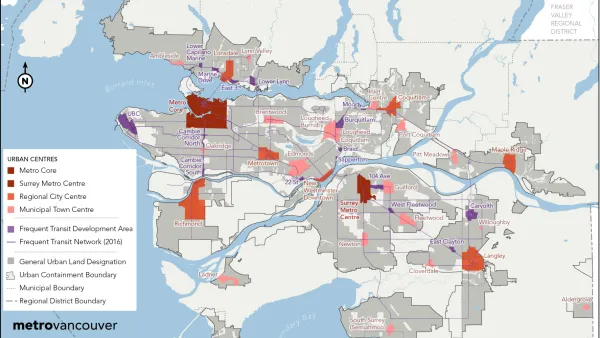
Vancouver Approves New Metro 2050 Regional Plan
The region around Vancouver in British Columbia has a new 30-year regional plan.

Different Approaches to Fast Growth in Idaho's Treasure Valley
Three cities on the periphery of the fast-growing Treasure Valley showcase different approaches to a sudden influx of newcomers.

Plan Bay Area 2050, Approved Last Week, Makes the Opinion Page
A traditionally controversial planning exercise, the regular update of the 30-year plan for the San Francisco Bay Area, has crossed the finish line again. Opponents aren't letting the issues rest, however.

Planetizen Federal Action Tracker
A weekly monitor of how Trump’s orders and actions are impacting planners and planning in America.

The state-sanctioned urbicide of Austin
People don’t kill cities. Freeways do.

US to reduce Colorado River water deliveries to Mexico
A new Colorado Treaty amendment reduces Mexico’s Colorado River water allocation by 250,000 acre feet.

5 New England states march closer to 800 megawatt wind energy project
Securing federal approval for the project may be complicated under the Trump administration, which has historically been hostile towards domestic wind power.

Baltimore to break ground on $50 million Transit Priority Project
The project will bring faster bus trips, safer streets and better bike connections to Baltimore.

Airbnb launches $250 million 'last-dollar financing' housing accelerator, makes first investment in Austin
The company will put $6.4 million towards affordable housing development in Texas’ capital.

FREE Course: Walkable City 1: Why Walkability?
After describing his path towards focusing on walkability as the essence of good planning, Jeff Speck marches through his five principal reasons for making more walkable places.
Reinventing Malls: Planning Alchemy—Turning Gray Fields Into Gold
The course focuses on the opportunities and imperatives that shape reinvention of mall sites.

Eagle County Government
Harvard University Graduate School of Design
Nashville Planning Department
The Architects Foundation
University of Cincinnati Online
The Pocatello Development Authority
The Urban Renewal Agency of the City of Pocatello
Journal of the American Planning Association