A few months ago, it seemed that a large group of renters in Minneapolis would be forced from their homes as the economic effects of the pandemic hit. Now these residents will own their forms in a city-supported cooperative.


"Thirty-eight families in south Minneapolis will gain ownership of their five apartment buildings after spending years battling with their landlord, Stephen Frenz, who had been trying to evict them," reports Max Nesterak.
The victory goes to Inquilinxs Unidxs Por Justicia (United Renters for Justice) after years of battling Frenz, who has a long-record of legal controversies—most ending poorly for him.
"In 2017, Frenz was banned from holding rental licenses in Minneapolis for five years because of chronic neglect, fraud and pest infestations," according to Nesterek. "He then owned more than 60 apartment buildings in Minneapolis and faced one of the largest class-action lawsuits against a private landlord in the country." Aster settling that lawsuit for $18.5 million, Frenz served time in the county workhouse for committing perjury during that case, according to Nesterek.
The sale of the property is made possible with an interest-free loan from the city, and the blessing of Mayor Jacob Frey. "The Land Bank Twin Cities bought the five properties in the Corcoran neighborhood for $7.1 million with a loan from the city and the Local Initiatives Support Corporation Twin Cities. The two entities will also provide financing to make necessary repairs to the properties," explains Nesterek. Ownership of the properties will be transferred to the residents over the next two years.
Read the full story: Tenants win ownership of properties from negligent landlord who tried to evict them

Where Permissive Zoning Codes Slowed Rent Growth
Recent analysis from the Pew Research Center identifies more support for zoning reform as a tool for maintaining the affordability of rental housing in U.S. cities.
Helping At-Risk Homeowners Stay Put With a Land Trust
For homeowners at risk of losing their home due to a medical crisis, divorce, or unexpected repair costs, City of Lakes Community Land Trust has been able to keep them in place by bringing their home into the land trust.
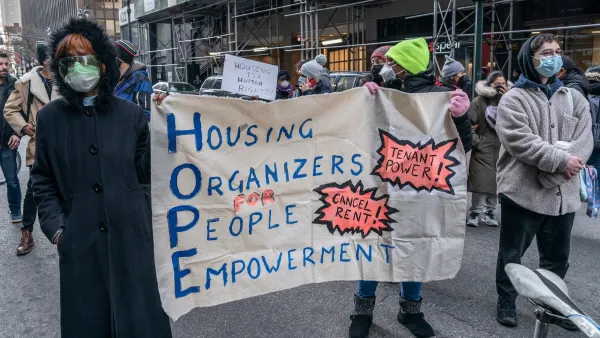
NYC 'Rental Ripoff' report calls for crackdown on negligent landlords
The report outlines strategies for empowering renters and transferring properties from 'low-road' landlords to those who focus on improved tenant outcomes.

Planetizen Federal Action Tracker
A weekly monitor of how Trump’s orders and actions are impacting planners and planning in America.

California plans to bury El Niño’s downpour
If the state plays its cards right, it may be able to store a billion acre-feet of El Niño’s water in aquifers.

Desperate measures: Advocates weigh draining Lake Powell to fill Colorado River
Draining the reservoir could reduce evaporation losses by a couple hundred thousand acre-feet.

Mamdani’s pied-à-terre tax survives legal challenge
A panel of judges found that the plaintiffs failed to demonstrate injury as a result of New York City's implementation of the tax.

Eastern Nebraska is running out of electricity
Data centers and electrification are straining eastern Nebraska’s grid, throttling economic development.

Seattle passes record-breaking transit services expansion
Proposition 1 will double the city’s transit tax to add 95,000 more bus trips and preserve 180,000 bus trips annually.

FREE Course: Walkable City 1: Why Walkability?
After describing his path towards focusing on walkability as the essence of good planning, Jeff Speck marches through his five principal reasons for making more walkable places.
Reinventing Malls: Planning Alchemy—Turning Gray Fields Into Gold
The course focuses on the opportunities and imperatives that shape reinvention of mall sites.

City of Rosemead
Rutgers University, Edward J. Bloustein School of Planning and Public Policy
One Hundred Miles
University of Michigan School for Environment and Sustainability (SEAS)
Hunter College, City University of New York (CUNY)
The Architects Foundation
City of Cambridge
Montrose County
The Pocatello Development Authority