The federal government's Opportunity Zones program is offering a tax break to a marina for superyachts and adjacent planned development in West Palm Beach, Florida.


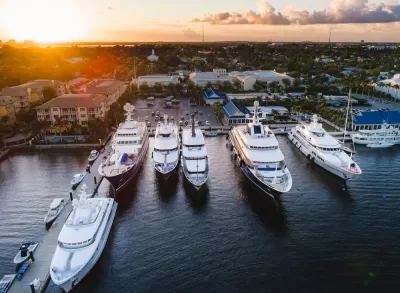
Justin Elliott, Jeff Ernsthausen, and Kyle Edwards report on how the Rybovich superyacht marina, located in West Palm Beach, Florida, just up the coast from Mar-a-Lago, came to be designated as an Opportunity Zone, and who stands to benefit from the designation.
Rybovich owner Wayne Huizenga Jr., son of the Waste Management and Blockbuster video billionaire Wayne Huizenga Sr., has long planned to build luxury apartment towers on the site, part of a development dubbed Marina Village.
Those planned towers, and the superyacht marina itself, are now in an area designated as an opportunity zone under President Donald Trump’s 2017 tax code overhaul, qualifying them for a tax break program that is supposed to help the poor.
Former Florida Governor Rick Scott "bestowed the tax break on the marina after a direct appeal from Huizenga Jr.," according to the article. "The state of Florida, based on an analysis of unemployment and poverty rates, had not originally intended to pick the census tract containing the superyacht marina for the program. But those plans changed in response to Huizenga’s lobbying…"
The article includes documentation of the process by which the marina and surrounding parcels won the Opportunity Zone designation.
Since its creation in the GOP tax reform bill of 2017, the Opportunity Zones program has faced repeated criticism for tax breaks delivered to wealthy land owners and developers in wealthy zip codes, seemingly far removed from the stated purpose of the program to deliver investment to economically distressed parts of the country.
Read the full story: A Trump Tax Break To Help The Poor Went To a Rich GOP Donor’s Superyacht Marina


Popularity of Opportunity Zone Program Grows During the Pandemic
Investors are looking for safe places to park capital gains as volatility roils the stock market. Opportunity zone programs fit the bill.

Shuttered Baltimore Hotel Will Become Affordable Housing
The project will create 303 new workforce housing units in a former downtown hotel.
Opinion: Congress Should Expand the Opportunity Zone Program
The federal economic development program has brought over $100 billion in private investment to revitalize struggling communities.

Planetizen Federal Action Tracker
A weekly monitor of how Trump’s orders and actions are impacting planners and planning in America.

California plans to bury El Niño’s downpour
If the state plays its cards right, it may be able to store a billion acre-feet of El Niño’s water in aquifers.

Desperate measures: Advocates weigh draining Lake Powell to fill Colorado River
Draining the reservoir could reduce evaporation losses by a couple hundred thousand acre-feet.

California city breaks ground on transit connector
The project includes three mobility hubs and a pedestrian bridge.

After public outcry, Massachusetts city releases housing development tracker
Cambridge’s tracker currently shows 250 housing projects in various stages of development.

40 years after approval, Chicago breaks ground on new park
The park honors Jean Baptiste Point du Sable, the city’s first permanent non-native settler.

FREE Course: Walkable City 1: Why Walkability?
After describing his path towards focusing on walkability as the essence of good planning, Jeff Speck marches through his five principal reasons for making more walkable places.
Reinventing Malls: Planning Alchemy—Turning Gray Fields Into Gold
The course focuses on the opportunities and imperatives that shape reinvention of mall sites.

City of Rosemead
Rutgers University, Edward J. Bloustein School of Planning and Public Policy
One Hundred Miles
Hunter College, City University of New York (CUNY)
The Architects Foundation
University of Cincinnati Online
City of Cambridge
Montrose County
The Pocatello Development Authority