The city of Compton has completed a draft environmental impact review of an ambitious plan to transform the blocks surrounding the Artesia Station on the Metro A Line.


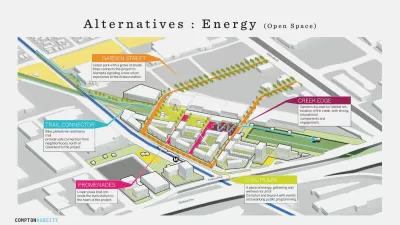
"The City of Compton has kicked off the environmental review period for a new specific plan for land use and development surrounding Metro's Artesia Station," reports Steven Sharp.
The Artesia Station is located on the line formerly known as the Blue Line—now known as the A Line in the Metro rail system. The Artesia Station is currently surrounded by warehouses and auto-oriented retail, according to Sharp. The specific plan would change that mix.
"The draft specific plan - created with the assistance of architecture firm SOM - envisions subdividing the large commercial tracts surrounding the transit hub, creating a collection of smaller blocks and sub-neighborhoods," according to Sharp.
The city of Compton has set up online presences both for the specific plan process. For even more details on the Artesia Station Specific Plan, see also a post written by Sharp in November 2018.
Read the full story: Compton Moves Forward With New Specific Plan for Artesia Station
New Plans for Transit Oriented Development in South Central L.A.
Los Angeles County recently adopted the Florence-Firestone Transit Oriented District Specific Plan.
A Transit and Land Use Planning Shift in Federal Way, Washington
Federal funding for Sound Transit's Federal Way Link extension and a new transit-oriented land use plan are changing the future of Federal Way.
Can We Resist Displacement From Transit-Oriented Development?
Transit stations increase nearby jobs and populations, but they could also contribute to displacement. What can we do differently?

Planetizen Federal Action Tracker
A weekly monitor of how Trump’s orders and actions are impacting planners and planning in America.

California plans to bury El Niño’s downpour
If the state plays its cards right, it may be able to store a billion acre-feet of El Niño’s water in aquifers.

Desperate measures: Advocates weigh draining Lake Powell to fill Colorado River
Draining the reservoir could reduce evaporation losses by a couple hundred thousand acre-feet.

Seattle passes record-breaking transit services expansion
Proposition 1 will double the city’s transit tax to add 95,000 more bus trips and preserve 180,000 bus trips annually.

Post election, Texas is no longer Musk’s 'AI oasis'
Elon Musk dolled out $446 million on the 2026 midterms, the most ever spent by a non-canidate.

Chicago voters approve permanent festival grounds, penalty for vacant property owners
Currently, major summer and fall festivals take over public parks for weeks at a time, drawing criticism from nearby residents

FREE Course: Walkable City 1: Why Walkability?
After describing his path towards focusing on walkability as the essence of good planning, Jeff Speck marches through his five principal reasons for making more walkable places.
Reinventing Malls: Planning Alchemy—Turning Gray Fields Into Gold
The course focuses on the opportunities and imperatives that shape reinvention of mall sites.

City of Rosemead
Rutgers University, Edward J. Bloustein School of Planning and Public Policy
One Hundred Miles
Hunter College, City University of New York (CUNY)
The Architects Foundation
University of Cincinnati Online
City of Cambridge
Montrose County
The Pocatello Development Authority