The city of Alexandria has begun to explore the idea of transforming sections of King Street into a car-free pedestrian zone.


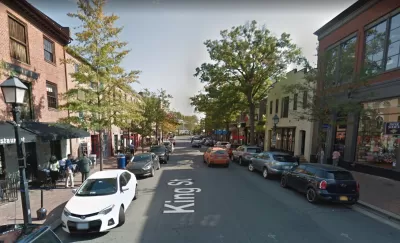
"A small section at the base of King Street in Alexandria, Virginia could become a car-free zone," reports Joanne Tang.
The proposal is still speculative, but "city staff are looking into closing some combination of the 100 block and 200 block of King Street to car traffic to make the space even more attractive and useful," according to Tang.
Tang also notes that even in the project's conceptual stage of development, the idea has provoked a windshield perspective from the Northern Virginia Transportation Authority.
Missy Schrott reported on the project earlier in August. Schott's coverage includes a quote from Alexandria Mayor Justin Wilson, who makes the case for a car-free street in the city: "There is very much a yearning for rethinking the way we use public space….Here, you have a space that attracts a lot of people, a lot of visitors, a lot of residents, and I think there’s a way to make that even more vital, even more attractive to the community."
Read the full story: Part of King Street in Alexandria could become car-free
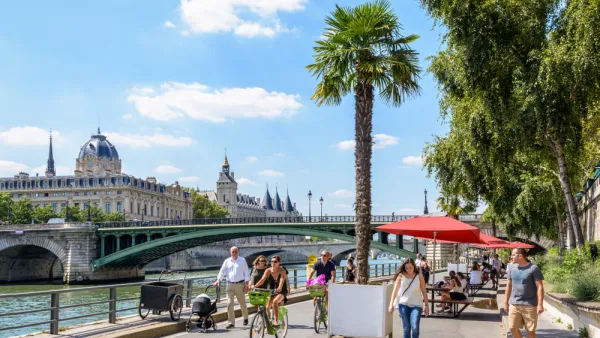
The Car-Free Revolution Continues in Paris
The city continues to reclaim space for pedestrians and cyclists.
Oslo's Car-Free Dreams Easier Said Than Done
Touted as a leader among the European cities moving toward car-free streets, Oslo's ambitions of removing all cars from the city center has hit some roadblocks.
Houston Launching Car-Free Streets Pilot Project
Starting in April, Houston will close 2.5 miles of streets to automobile traffic between 11 am and 3 pm. Additional street closures will follow in May.

Desperate measures: Advocates weigh draining Lake Powell to fill Colorado River
Draining the reservoir could reduce evaporation losses by a couple hundred thousand acre-feet.

Eastern Nebraska is running out of electricity
Data centers and electrification are straining eastern Nebraska’s grid, throttling economic development.

Malls are becoming the midtowns of the future
Mall and office park redevelopments are a generational opportunity to create new nodes of urbanity.

NYC breaks ground on anti-flooding infrastructure project
New York City's new system will reduce stormwater flows to local sewers by 90%.

One Kentucky town’s secret to affordable housing
The Smoketown Community Land Trust has already built seven affordable homes for community members.

Houston gains petal-shaped cooling infrastructure to make streets more ‘delightful’
The city has installed the pavilions along 15 blocks in Houston.

FREE Course: Walkable City 1: Why Walkability?
After describing his path towards focusing on walkability as the essence of good planning, Jeff Speck marches through his five principal reasons for making more walkable places.
Reinventing Malls: Planning Alchemy—Turning Gray Fields Into Gold
The course focuses on the opportunities and imperatives that shape reinvention of mall sites.

City of Rosemead
Rutgers University, Edward J. Bloustein School of Planning and Public Policy
One Hundred Miles
University of Michigan School for Environment and Sustainability (SEAS)
Hunter College, City University of New York (CUNY)
The Architects Foundation
City of Cambridge
Montrose County
The Pocatello Development Authority