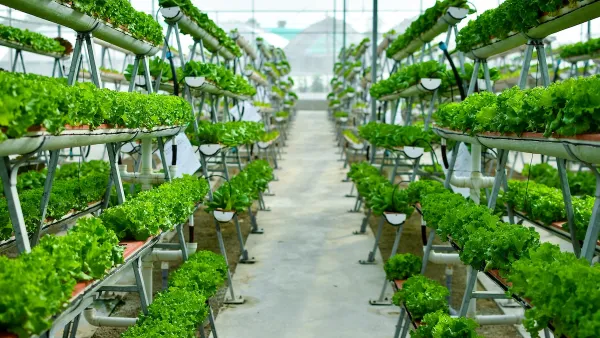
A new indoor vertical farming venture in Chicago seeks to change agricultural production by harnessing technology.



"Growing produce in controlled environments, including greenhouses and indoor vertical farms, has gained steam as a sustainable solution to the food needs of a growing population because it uses less land and far less water than traditional farming and can be done year-round near cities, reducing the distance the food travels," writes Alexia Elejalde-Ruiz.
Chicago’s Backyard Fresh Farm is an indoor vertical farm that is trying to tackle the many challenges that have hindered similar agricultural operations in the past. Cameras, artificial intelligence software, and robots have significantly reduced labor and energy costs and resulted in competitively priced, high-quality produce outputs.
"[Jake] Counne is in discussions with landlords in Chicago and Calumet City, where he hopes to lease 35,000 square feet in which he says could yield 600,000 pounds of produce a year, in towers stacked 21 feet high, with only six laborers. His long-term vision is to open 100,000-square-foot facilities near major metropolitan areas around the country, each with capacity to grow 6 million pounds," reports Elejalde-Ruiz.

Vertical Farms Grow in Office Buildings
Office conversion is taking an agricultural turn.

New Energy Rating System for Chicago Buildings
The city will evaluate all buildings over 50,000 square feet and make the energy performance ratings and information easily accessible.
Via Rideshare Service Expands in Chicago
The company hopes that a broader service area and discounted rides will help people better access transit services.

The state-sanctioned urbicide of Austin
People don’t kill cities. Freeways do.

US to reduce Colorado River water deliveries to Mexico
A new Colorado Treaty amendment reduces Mexico’s Colorado River water allocation by 250,000 acre feet.

New Jersey’s second-largest city bans standalone data centers
Jersey City will continue to allow co-location facilities, such as those meant for research institutions that store their own data.

Amtrak not solely to blame for New Jersey commuter rail's unreliability, report finds
A new study from the Garden State Initiative found that NJ Transit’s budget grew 20% across a 4 year period, but reliability declined significantly over the same period.

EPA erases limits on planet-warming pollution from power plants
Under Monday’s plan, power plants would still have some limits on how much mercury, arsenic and other contaminants they can emit.

Phoenix announces new on-demand transit service, more frequent RAPID buses
Both new services will launch in October, and are part of Phoenix's Project Effective Access Solutions for Easing Congestion.

FREE Course: Walkable City 1: Why Walkability?
After describing his path towards focusing on walkability as the essence of good planning, Jeff Speck marches through his five principal reasons for making more walkable places.
Reinventing Malls: Planning Alchemy—Turning Gray Fields Into Gold
The course focuses on the opportunities and imperatives that shape reinvention of mall sites.

Eagle County Government
Harvard University Graduate School of Design
Nashville Planning Department
The Architects Foundation
University of Cincinnati Online
The Pocatello Development Authority
The Urban Renewal Agency of the City of Pocatello
Journal of the American Planning Association