The economy is improving in places like Texas, but a closer look indicates that cities are taking off while rural areas are lagging behind.


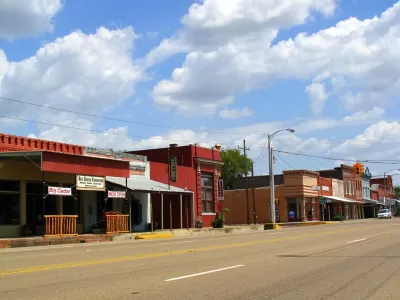
Job growth is up in Texas, but the effects have been concentrated in the state’s largest cities: Austin, Dallas, Houston, and San Antonio. "No state — not even California, long held up as the embodiment of America’s widening geographic inequality — has seen a larger post-recession divergence between its elite cities and everywhere else," writes Jim Tankersley.
It is a trend that is playing out across the country, where urban areas are drawing in educated workers and professional industries as poorer, rural areas languish. "Research from the [Economic Innovation Group] found that from 2008 to 2016, the most prosperous ZIP codes in Texas — heavily concentrated in those star metro areas — accounted for more than two-thirds of the state’s net growth in jobs and business establishments," notes Tankersley.
He explores developments in Longview, a town in the eastern part of Texas. Longview has gained only about 1,800 jobs in the last decade, and in recent years it has seen a net loss of businesses. City officials want to offer amenities that will attract young professionals—like parks, trails, and breweries—but they realize the challenges.
“Ms. [Vicki D.] Jones’s and others’ hope is that Longview can sell a particular type of young worker on a mix of the values they grew up with, with just enough of the big-city amenities to make a smaller town attractive,” says Tankersley.
FULL STORY: The ‘Texas Miracle’ Missed Most of Texas

A Housing and Eviction Crisis Still Hangs Over the U.S., Just Like the Pandemic
Checking in with the numerous risks in the housing market as the economic fallout of the pandemic as approaches it approaches its second year.
Helping City Workers Live in the City
Local municipalities are offering housing incentives to draw employees and help them live closer to their jobs.
Understanding Cities Through Their Life Cycles
Cities go through ups and downs over time, and where a city is in its longer history can reveal the reasons behind population changes.

Planetizen Federal Action Tracker
A weekly monitor of how Trump’s orders and actions are impacting planners and planning in America.

The state-sanctioned urbicide of Austin
People don’t kill cities. Freeways do.

US to reduce Colorado River water deliveries to Mexico
A new Colorado Treaty amendment reduces Mexico’s Colorado River water allocation by 250,000 acre feet.

5 New England states march closer to 800 megawatt wind energy project
Securing federal approval for the project may be complicated under the Trump administration, which has historically been hostile towards domestic wind power.

Baltimore to break ground on $50 million Transit Priority Project
The project will bring faster bus trips, safer streets and better bike connections to Baltimore.

Airbnb launches $250 million 'last-dollar financing' housing accelerator, makes first investment in Austin
The company will put $6.4 million towards affordable housing development in Texas’ capital.

FREE Course: Walkable City 1: Why Walkability?
After describing his path towards focusing on walkability as the essence of good planning, Jeff Speck marches through his five principal reasons for making more walkable places.
Reinventing Malls: Planning Alchemy—Turning Gray Fields Into Gold
The course focuses on the opportunities and imperatives that shape reinvention of mall sites.

Eagle County Government
Harvard University Graduate School of Design
Nashville Planning Department
The Architects Foundation
University of Cincinnati Online
The Pocatello Development Authority
The Urban Renewal Agency of the City of Pocatello
Journal of the American Planning Association