The U.S. Senate still needs to approve the bill that would spend $5 million in initial funding for the Great Lakes Hyperloop System.


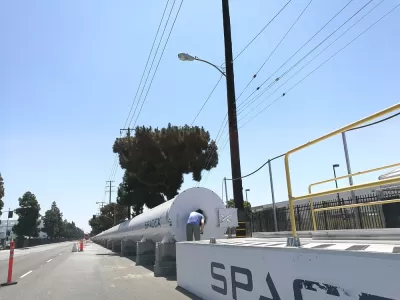
"Five million dollars in initial funding for the Great Lakes Hyperloop System, an experimental high-speed transportation project, was included in legislation voted on by the U.S. House of Representatives in late June," reports Kim Palmer.
"The passage of the 2020 Transportation, Housing and Urban Development Appropriation bill by the House provides the funds for the U.S. Department of Transportation to create a regulatory framework for development of a hyperloop system."
The Chicago-to-Cleveland hyperloop route first made news in February 2018, when the Northeast Ohio Areawide Coordinating Agency (NOACA) spent $1.2 million on a grant to fund a six-month feasibility study for the project. That study is expected for completion this fall, according to Palmer.
Read the full story: Initial funding for Cleveland-to-Chicago hyperloop passes House, moves to Senate

Experts: Great Lakes Hyperloop Study Full of Dubious Claims
About that Hyperloop report…
The Crucial Role of Suburban Voters in the Midterms
Suburban voters were instrumental in preventing a 'red wave' on Election Day and on December 6 in the Georgia U.S. Senate runoff election, enabling the Democrats to win a 51st Senate seat.
Chicago-Cleveland Hyperloop Estimated at $29.8 Billion
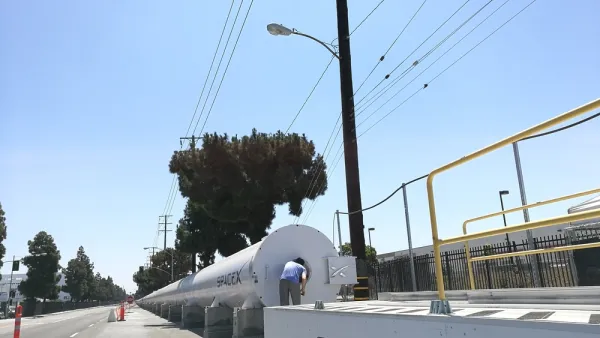
A feasibility analysis published today estimates costs and benefits for the still-unproven Hyperloop technology, as envisioned for a route connecting Cleveland and Chicago.

Planetizen Federal Action Tracker
A weekly monitor of how Trump’s orders and actions are impacting planners and planning in America.

California plans to bury El Niño’s downpour
If the state plays its cards right, it may be able to store a billion acre-feet of El Niño’s water in aquifers.

Desperate measures: Advocates weigh draining Lake Powell to fill Colorado River
Draining the reservoir could reduce evaporation losses by a couple hundred thousand acre-feet.

Mamdani’s pied-à-terre tax survives legal challenge
A panel of judges found that the plaintiffs failed to demonstrate injury as a result of New York City's implementation of the tax.

Eastern Nebraska is running out of electricity
Data centers and electrification are straining eastern Nebraska’s grid, throttling economic development.

Seattle passes record-breaking transit services expansion
Proposition 1 will double the city’s transit tax to add 95,000 more bus trips and preserve 180,000 bus trips annually.

FREE Course: Walkable City 1: Why Walkability?
After describing his path towards focusing on walkability as the essence of good planning, Jeff Speck marches through his five principal reasons for making more walkable places.
Reinventing Malls: Planning Alchemy—Turning Gray Fields Into Gold
The course focuses on the opportunities and imperatives that shape reinvention of mall sites.

City of Rosemead
Rutgers University, Edward J. Bloustein School of Planning and Public Policy
One Hundred Miles
University of Michigan School for Environment and Sustainability (SEAS)
Hunter College, City University of New York (CUNY)
The Architects Foundation
City of Cambridge
Montrose County
The Pocatello Development Authority