Los Angeles transit planners wants to connect two of its rail lines with a bus rapid transit line. The idea has critics.


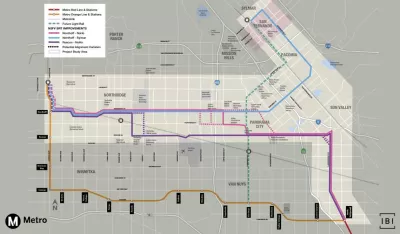
The Los Angeles County Transportation Authority (Metro) is considering a bus rapid transit lane to run through the San Fernando Valley, but the project has encountered public resistance before even beginning environmental review. A recently formed group called "Save the San Fernando Valley" complained that the public had not had ample time to understand and comment on the project.
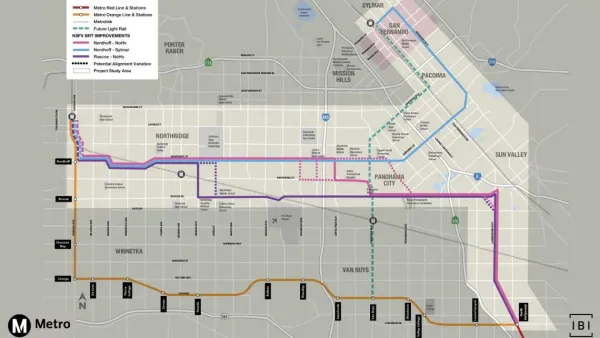
The exact route of the bus lane from which the group is hoping to save The Valley has yet to be determined. Some argue the bus would be less disruptive if it ran on Roscoe Boulevard rather than Nordhoff Street. However, "Running the entire project along Roscoe, however, would mean bypassing California State University, Northridge. School officials have pushed hard for better transit options for students, and Metro staff estimates that ridership on the bus would be highest between the university and the forthcoming light rail line to the east,” Elijah Chiland reports for Curbed. Still, the group thinks the disruption to parking and traffic on Nordhoff makes the bus line an unworkable project.
Supporters of the project point out, “The bus line would provide key connections to a planned light rail line along Van Nuys Boulevard and the Orange Line, an existing rapid bus that travels in dedicated lanes to the south of the proposed North Valley route,” Chiland writes. Metro hopes the project will be complete in time for the Olympics.
Bus rapid transit proposals have had trouble with local neighborhood groups in Los Angeles in recent weeks. Another proposal for a route connecting The Valley to the nearby city of Pasadena also encountered strident local opposition earlier this month.
Read the full story: ‘Stop this madness’: Valley residents trying to block bus rapid transit

New Bus Rapid Transit Line Proposed for L.A.'s San Fernando Valley
Measure M, approved by L.A. County voters in 2016, is enabling a slew of transit projects in the San Fernando Valley.
Controversial BRT Plans Revised in Los Angeles
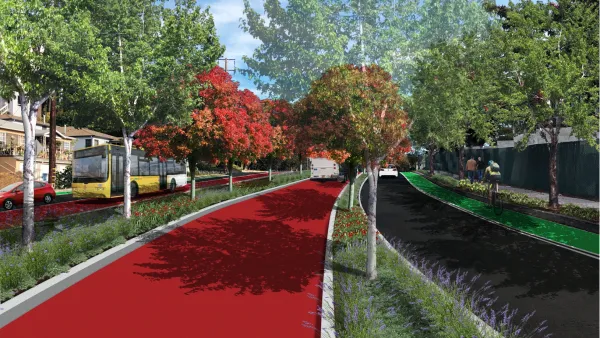
The proposed changes to plans for a bus rapid transit route on Colorado Boulevard are an attempt to compromise between competing community concerns.
Details of the North Hollywood-Pasadena Bus Rapid Transit Line
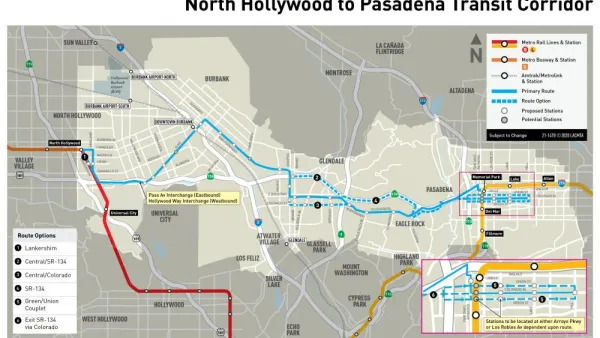
Still under environmental review, plans are still being made for the bus rapid transit line that would connect North Hollywood and Pasadena.

Planetizen Federal Action Tracker
A weekly monitor of how Trump’s orders and actions are impacting planners and planning in America.

The state-sanctioned urbicide of Austin
People don’t kill cities. Freeways do.

US to reduce Colorado River water deliveries to Mexico
A new Colorado Treaty amendment reduces Mexico’s Colorado River water allocation by 250,000 acre feet.

Nation's most wind-powered state turns to coal as data centers increase energy demand
For the first time in decades, Iowa has increased its generation of coal power.

NYC cools commuters with city's first rain garden above a bus stop
New York City officials say the plants in the rain garden can absorb 16 gallons of rainwater during heavy storms.

Brightline West’s future may rely on $6 billion federal loan
The company has until Nov. 2 to make a $400 million equity investment into its proposed high-speed rail line.

FREE Course: Walkable City 1: Why Walkability?
After describing his path towards focusing on walkability as the essence of good planning, Jeff Speck marches through his five principal reasons for making more walkable places.
Reinventing Malls: Planning Alchemy—Turning Gray Fields Into Gold
The course focuses on the opportunities and imperatives that shape reinvention of mall sites.

Greater Baltimore Committee
Eagle County Government
Harvard University Graduate School of Design
The Architects Foundation
University of Cincinnati Online
The Pocatello Development Authority
The Urban Renewal Agency of the City of Pocatello
Journal of the American Planning Association