The mayor of Newton says the city's planning department is stretched too thin, with several ordinances and large development proposals in the works.


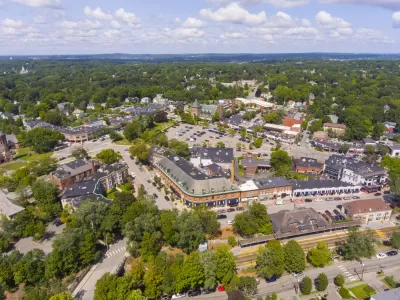
"Newton Mayor Ruthanne Fuller is pumping the brakes on her administration’s efforts to rewrite the city’s zoning rules," reports John Hilliard.
"In a letter to city councilors, Fuller said she has asked the Planning Department to wait until 2020 to deliver a final draft of the new citywide zoning ordinance — the first such overhaul in 32 years — for the City Council’s approval," according to Hilliard.
Mayor Fuller's decision followed public feedback, but the letter also credited "the city’s already 'sizeable workload' reviewing two large-scale development proposals and carrying out other planning efforts" in deciding to pause the code rewrite process.
Hilliard goes into greater detail about the "larger debate over development" in Newtown. Northland Investment Corp. has proposed a 14-building development at Needham and Oak streets that would add 800 residential units, 180,000 square feet of office, and 115,000 square feet of retail and community space. A separate proposal would add ten buildings, with 675 residential units, 611,000 square feet of office, 194 hotel rooms, and 611,000 square feet of retail at the Riverside MBTA station. "[Planners in Newton] are also working on “vision plans” for Riverside and Washington Street, a climate action plan, and an inclusionary zoning bylaw to promote more affordable housing."
Read the full story: Newton’s mayor delays revamping citywide zoning

City Council Controversy Threatens L.A.’s Proposed Downtown Plan
A Los Angeles Times editorial explains how political intrigue is spilling over into planning frustration in the city of Los Angeles.

Philadelphia City Council Pushing for More Control Over Zoning Variances
A cause abandoned by the Philadelphia City in 2019 is on the table again.

Developer Sues L.A. After Area Planning Commissioners Reject Multi-Family Project
A development controversy also now an expanding legal controversy, after a local planning commission rejected a controversial development proposal allowed by zoning.

Planetizen Federal Action Tracker
A weekly monitor of how Trump’s orders and actions are impacting planners and planning in America.

California plans to bury El Niño’s downpour
If the state plays its cards right, it may be able to store a billion acre-feet of El Niño’s water in aquifers.

Desperate measures: Advocates weigh draining Lake Powell to fill Colorado River
Draining the reservoir could reduce evaporation losses by a couple hundred thousand acre-feet.

Mamdani’s pied-à-terre tax survives legal challenge
A panel of judges found that the plaintiffs failed to demonstrate injury as a result of New York City's implementation of the tax.

Eastern Nebraska is running out of electricity
Data centers and electrification are straining eastern Nebraska’s grid, throttling economic development.

Seattle passes record-breaking transit services expansion
Proposition 1 will double the city’s transit tax to add 95,000 more bus trips and preserve 180,000 bus trips annually.

FREE Course: Walkable City 1: Why Walkability?
After describing his path towards focusing on walkability as the essence of good planning, Jeff Speck marches through his five principal reasons for making more walkable places.
Reinventing Malls: Planning Alchemy—Turning Gray Fields Into Gold
The course focuses on the opportunities and imperatives that shape reinvention of mall sites.

City of Rosemead
Rutgers University, Edward J. Bloustein School of Planning and Public Policy
One Hundred Miles
University of Michigan School for Environment and Sustainability (SEAS)
Hunter College, City University of New York (CUNY)
The Architects Foundation
City of Cambridge
Montrose County
The Pocatello Development Authority