Environmentalists challenged the U.S. Environmental Protection Agency and won.


Becky Hammer writes on behalf of the National Resources Defense Council to report that earlier this month, "a federal district court in Maryland ruled that the U.S. Environmental Protection Agency (EPA) wrongfully denied our petition to regulate harmful runoff pollution from commercial, industrial, and institutional sites in Baltimore’s Back River watershed."
"When EPA denied the petition in 2016, the agency refused to consider whether stormwater pollution from the sites is contributing to violations of water quality standards, as the Clean Water Act requires. Now a court has ruled that EPA’s decision was unlawful," adds Hammer.
The NRDC, along with American Rivers and Blue Water Baltimore, filed the petition in 2015, pushing the EPA to regulate runoff in the watershed under powers granted by the Clean Water Act.
Now the EPA must reconsider the petition, and could potentially decide to begin regulating pollution sources in the watershed, which drains Baltimore city and county. The river is already legally designated as "impaired" due to high levels of nitrogen, phosphorus, and sediment pollution.
FULL STORY: NRDC Wins Court Victory on Stormwater Pollution in Baltimore


Comments Closed for Significant Changes to 'Waters of the United States' Rule
The Trump administration has spent the first two years of its time in office trying to overturn key provisions of the "Waters of the United States" rule.
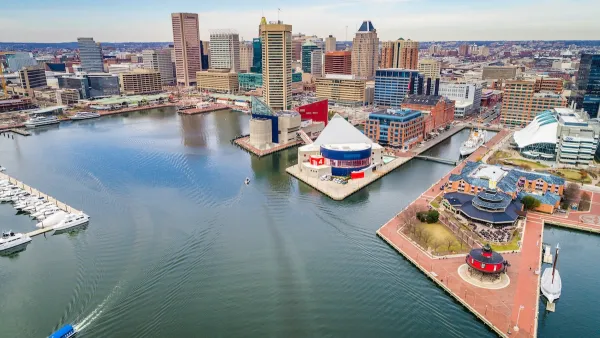
Baltimore Invests Billions to Clean its Waterways
Like Paris, the city has been working to improve its wastewater system and make local waterways safe for swimming.
Fifty Years After the Clean Water Act, Half of U.S. Waters Are Unsafe for Humans and Fish
A study of U.S. waterways shows that around half of lakes, rivers, and streams in the U.S. are too toxic to swim or fish in.

Planetizen Federal Action Tracker
A weekly monitor of how Trump’s orders and actions are impacting planners and planning in America.

The state-sanctioned urbicide of Austin
People don’t kill cities. Freeways do.

US to reduce Colorado River water deliveries to Mexico
A new Colorado Treaty amendment reduces Mexico’s Colorado River water allocation by 250,000 acre feet.

Baltimore to break ground on $50 million Transit Priority Project
The project will bring faster bus trips, safer streets and better bike connections to Baltimore.

Airbnb launches $250 million 'last-dollar financing' housing accelerator, makes first investment in Austin
The company will put $6.4 million towards affordable housing development in Texas’ capital.

Guerilla urbanists are building DIY bus stop benches in Chicago
A before-and-after of one of the bus stops with a new bench. The new benches are not officially sanctioned or permitted, but the residents who placed them hope they will be the start of a network of DIY benches across the city.

FREE Course: Walkable City 1: Why Walkability?
After describing his path towards focusing on walkability as the essence of good planning, Jeff Speck marches through his five principal reasons for making more walkable places.
Reinventing Malls: Planning Alchemy—Turning Gray Fields Into Gold
The course focuses on the opportunities and imperatives that shape reinvention of mall sites.

Eagle County Government
Harvard University Graduate School of Design
Nashville Planning Department
The Architects Foundation
University of Cincinnati Online
The Pocatello Development Authority
The Urban Renewal Agency of the City of Pocatello
Journal of the American Planning Association