Bus transit advocates in the state of Minnesota are happy to see they have a friend in the Governor's Office.



Minnesota Governor Tim Walz revealed a proposed state budget that provides serious support for public bus transit around the state. "[Governor Walz] wants electric coaches, new routes and more frequent service," reports Jessica Lee.
"The additions, of course, would come at a cost," adds Lee. "Those in the seven-county metro area (Hennepin, Ramsey, Anoka, Washington, Dakota, Scott, Carver) would face an eighth-of-a-cent sales tax increase — on top of the budget’s 20-cent gas tax increase statewide — if the governor’s $324 million transportation package were adopted."
The State Legislature will have to determine how much of Gov. Walz's budget is doable and how much will be left on the cutting room floor. A separate article by Peter Callaghan digs into the political viability of the proposed budget.
Also, check the slight salacious headline—anyone raised in the '90s will catch the reference.
Read the full story: He likes big bus: Walz’s budget proposal aims to boost transit
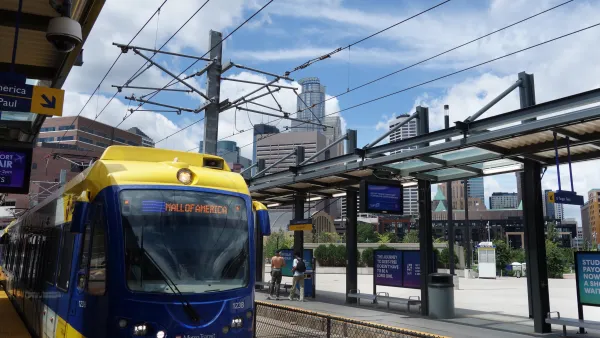
The Advocacy Coalition Behind Minnesota’s Transit Funding Victory
The Minnesota State Legislature recently approved one of the most significant funding bills ever devoted to transit at the state level. The bill required rare political alignment and a new brand of advocacy.
Election 2019: Planning and Development Related Results Roundup
Many states and cities around the country voted on November 5, 2019 to decide matters related to the future of the built environment.
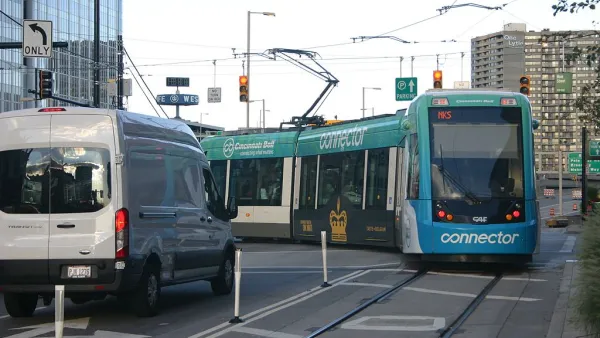
Management Divorce for the Cincinnati Streetcar
Efforts to bolster support for a countywide sales tax levy in Hamilton County, Ohio, are pushing the city to fire SORTA as the manager of the troubled Cincinnati Bell Connector.

Desperate measures: Advocates weigh draining Lake Powell to fill Colorado River
Draining the reservoir could reduce evaporation losses by a couple hundred thousand acre-feet.

Eastern Nebraska is running out of electricity
Data centers and electrification are straining eastern Nebraska’s grid, throttling economic development.

Move over, LA: St. Louis gears up for Olympics, invests millions in downtown redevelopment
The Missouri city will host the 2028 Olympic soccer group stage and knockout matches.

Mass. votes against statewide minimum lot size for single-family homes
Over 2 million residents voted on Question 7; it was decided by just over 30,000 votes.

Maryland’s $15 billion bridge project gains key approval
The Maryland Transit Authority said the project will create over 60,000 jobs and add $23 billion to the local economy.

‘No clear next steps’ for Chicago's permanent festival grounds
Eleventh Ward Ald. Nicole Lee has suggested Soldier Field as a possible location for the permanent event space.

FREE Course: Walkable City 1: Why Walkability?
After describing his path towards focusing on walkability as the essence of good planning, Jeff Speck marches through his five principal reasons for making more walkable places.
Reinventing Malls: Planning Alchemy—Turning Gray Fields Into Gold
The course focuses on the opportunities and imperatives that shape reinvention of mall sites.

City of Rosemead
Rutgers University, Edward J. Bloustein School of Planning and Public Policy
One Hundred Miles
University of Michigan School for Environment and Sustainability (SEAS)
Hunter College, City University of New York (CUNY)
The Architects Foundation
City of Cambridge
Montrose County
The Pocatello Development Authority