Massive projects stayed a dream in 20th century Boston. Lessons from the failed ideas of the past inform a more complete understanding of the city in the 21st century.


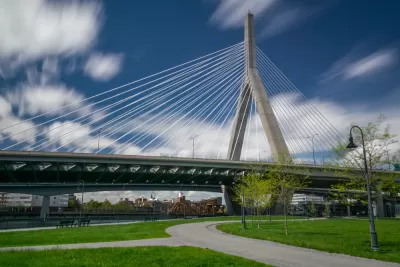
Anthony Flint takes a tour of what might have been in Boston, where there's a uniquely long history of massive projects that never got built. Flint it mining history for lessons about what separates the never built from the transformative.
Lessons considered by Flint and sources: that Bostonians are easily spooked, or that Boston has constantly sought to expand outward (by making more land, literally) or upward (history is full of failed skyscraper ideas).
Five projects are particularly informative, according to Flint:
- Inner Belt, Southwest Expressway, and Northwest Expressway (1907-1971)
- Mission Control at Kendall Square (1961-1968)
- Completion of the Emerald Necklace (1897-present)
- City Hall Plaza improvements, restoration of Hanover Street, Congress Street pedestrian bridge (circa 1965-present)
- South Boston Megaplex; football and baseball stadiums (1990-2000)
Implied in some of the discussion with reference to specific projects is that some of these projects could still be built.
For more on the "never built" or "unbuilt" trope, see previous explorations from Los Angeles, Chicago, New York, and Seattle.
Read the full story: Five plans that would’ve changed the face of Boston

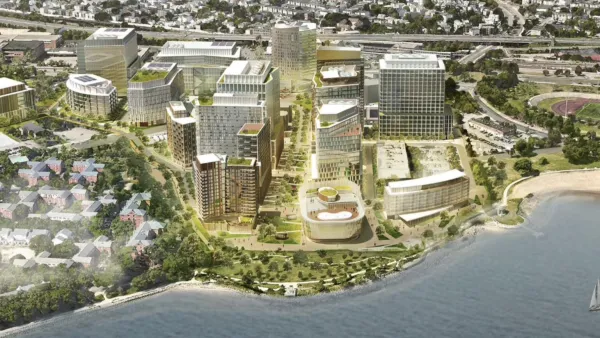
Mega-Project Aims to Transform South Boston
Developers with a ground lease for land owned by the University of Massachusetts Boston want to build a new mixed-use development to rival Kendall Square in nearby Cambridge.
Boston sues Trump administration over revoked infrastructure grant
The Trump administration withdrew the infrastructure grant because less than 1% of the money would go to electric vehicle charging infrastructure.
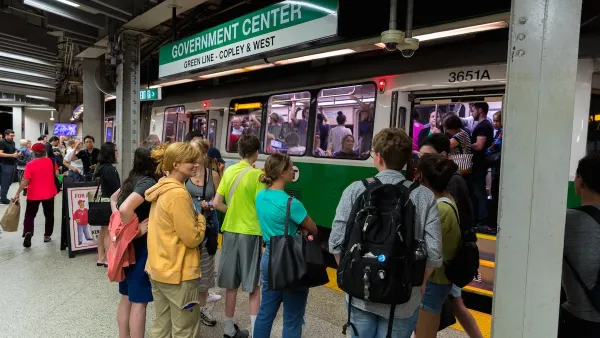
Boston has spent millions making the Green Line more accessible — and there’s no end in sight
While the city has invested millions into expanding and adding platforms to the Green Line to make it more accessible, new train cars set to arrive next year will be too tall for disabled passengers to board without raising the current platforms.

Planetizen Federal Action Tracker
A weekly monitor of how Trump’s orders and actions are impacting planners and planning in America.

Northwest rail fans eager for Sept. 30 debut of Amtrak’s Airo fleet
Get ready for that new train smell and more seats. But they won’t go faster or run more frequently on the Cascades route in Washington and Oregon.
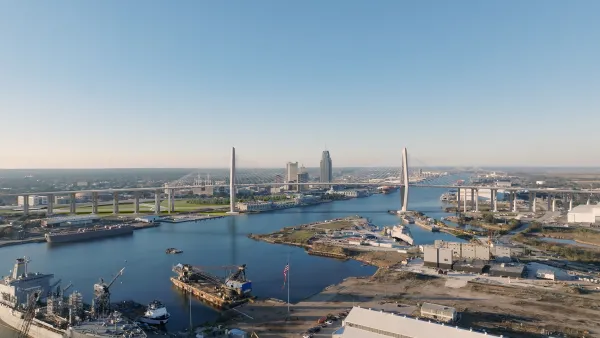
Alabama scores up to $2.5 billion federal loan for largest infrastructure project in state’s history
The Mobile River Bridge and Bayway Project aims to ease congestion at Alabama’s worst bottleneck.

Novel study finds extreme state-by-state disparity in housing construction timelines
The first comprehensive working paper on U.S. construction timelines also found that the permitting process for multi-family projects has slowed nationwide.

California may destroy its beaches trying to save homes from El Niño
Boulders and seawalls can protect homes from waves, but ultimately destroy sandy beaches.

California high-speed rail accomplishes only one legislative goal in 2026
The majority of the agency's failed pitches were never developed into written proposals.

FREE Course: Walkable City 1: Why Walkability?
After describing his path towards focusing on walkability as the essence of good planning, Jeff Speck marches through his five principal reasons for making more walkable places.
Reinventing Malls: Planning Alchemy—Turning Gray Fields Into Gold
The course focuses on the opportunities and imperatives that shape reinvention of mall sites.

City of Thousand Oaks
City of Wisconsin Rapids
Harvard University Graduate School of Design
The Architects Foundation
University of Cincinnati Online
Northern Illinois Transit Authority (NITA)
The Pocatello Development Authority
The Urban Renewal Agency of the City of Pocatello