The bills seek to end landlords' ability to offer rent discounts and then calculate increases based on the original price, rather than on what a tenant was actually paying.


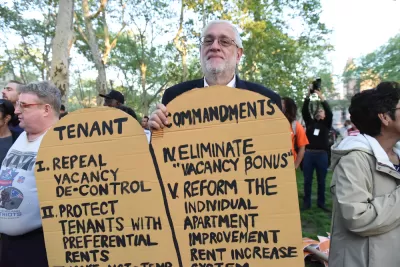
Tenants of rent-controlled units in Washington D.C. may get a reprieve from a misleading practice if the D.C. Council passes a set of new bills. Jon Steingart writes, "Councilmember Anita Bonds (D-At Large) introduced a pair of bills that would update how rent increases are determined under the city's rent control law. They target a practice called rent concessions some landlords use to offer discounts on rent, then they calculate rent increases on the non-discounted amount."
"Bonds' legislation," Steingart goes on, "would clarify that a rent adjustment should be based on the amount a tenant actually pays, rather than some higher amount a landlord says it could charge."
Bonds drew from a January decision by the city's Rental Housing Commission that rent increases should be based on "the amount actually demanded, received, or charged" by landlords. Under the new rules, landlords could still give tenants rent discounts. But adjustments would be calculated based on the discounted amount.
Given the council's legislative environment and schedule, Steingart writes that the legislation likely "faces uphill odds" of becoming law.
FULL STORY: Legislation intended to end sharp rent increases lands in the DC Council


Rent Control Debated in the Nation's Capital
District council members and local tenant advocates are engaged in a bit of tug of war about how far the District should go to limit the amount landlords can raise rents.

Opinion: Rent Control Works
A dozen arguments for why rent control is effective and necessary in the current housing crisis.
More Cities Supporting Legal Counsel as a Right for All Renters
Cities, headlined by New York, are finding new ways to support renters facing eviction.

Planetizen Federal Action Tracker
A weekly monitor of how Trump’s orders and actions are impacting planners and planning in America.

The state-sanctioned urbicide of Austin
People don’t kill cities. Freeways do.

US to reduce Colorado River water deliveries to Mexico
A new Colorado Treaty amendment reduces Mexico’s Colorado River water allocation by 250,000 acre feet.

Baltimore to break ground on $50 million Transit Priority Project
The project will bring faster bus trips, safer streets and better bike connections to Baltimore.

Airbnb launches $250 million 'last-dollar financing' housing accelerator, makes first investment in Austin
The company will put $6.4 million towards affordable housing development in Texas’ capital.

Guerilla urbanists are building DIY bus stop benches in Chicago
A before-and-after of one of the bus stops with a new bench. The new benches are not officially sanctioned or permitted, but the residents who placed them hope they will be the start of a network of DIY benches across the city.

FREE Course: Walkable City 1: Why Walkability?
After describing his path towards focusing on walkability as the essence of good planning, Jeff Speck marches through his five principal reasons for making more walkable places.
Reinventing Malls: Planning Alchemy—Turning Gray Fields Into Gold
The course focuses on the opportunities and imperatives that shape reinvention of mall sites.

Eagle County Government
Harvard University Graduate School of Design
Nashville Planning Department
The Architects Foundation
University of Cincinnati Online
The Pocatello Development Authority
The Urban Renewal Agency of the City of Pocatello
Journal of the American Planning Association