Urban environment author Carol Berens visits the new Cornell Tech campus on New York City’s Roosevelt Island.


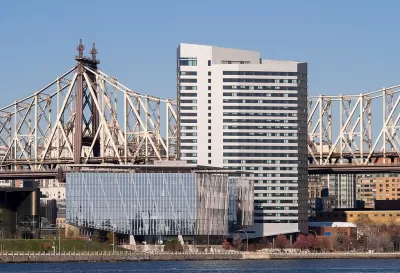
New York is making an ambitious play for a piece of Silicon Valley’s tech innovation industry by opening it’s Cornell Tech campus on Roosevelt Island. There it focuses on the interplay between university research and birthing innovative businesses and industry, as has proven successful in places like the Bay Area, Boston, and San Diego. Carol Berens, an urban environment author and former VP of the Empire State Development Corporation, visited the recently opened campus and shares her observations about its architectural form and connection to the city. It cost $2 billion, has lots of glass, views, space, light, and hope—it’s connected to the city’s transit structure—but not many students yet (300 now, 2,000 expected). For more details, please see the source article.
Read the full story: Cornell Tech moves into its Roosevelt Island Home

Cornell's $2 Billion Campus in New York Will 'Bridge' Academia and Corporations
The eagerly anticipated addition of a $2 billion campus for Cornell on Roosevelt Island will include a gesture toward the new model of innovation economy that directly connects universities with their cities.
The Story Behind Stanford's Withdrawl from NYC Tech Campus Competition
Did it seem odd when Stanford University withdrew from a competition to build a new $2 billion Applied Sciences and Engineering campus in New York City just as officials were about to decide the winner, and Stanford was the perceived front-runner?

First New Bridge to Manhattan in Decades Proposed Just for Pedestrians and People on Bikes
Introducing the proposed Queens Ribbon Bridge, a $100 million idea to connect Manhattan to Long Island City in Queens, by way of Roosevelt Island.

Planetizen Federal Action Tracker
A weekly monitor of how Trump’s orders and actions are impacting planners and planning in America.

Amtrak, CN end decades-long dispute with eight-year agreement
The new operating agreement establishes an updated framework for the companies to work together, including processes to resolve disputes.

Northwest rail fans eager for Sept. 30 debut of Amtrak’s Airo fleet
Get ready for that new train smell and more seats. But they won’t go faster or run more frequently on the Cascades route in Washington and Oregon.

St. Louis Metro to test if single-car trains can reduce operating costs, maintain rider satisfaction
The pilot program will run from October to spring 2027, and begin with one single-car train operating on Metrolink’s Red and Blue lines.

Pennsylvania is building data centers in abandoned mines
Housing data centers in mines provides an alternative to destroying local forests and may spare residents from data centers’ noise and air pollution.

If Corpus Christi can’t revive desalination plant project, it may owe Texas $235 million
Earlier this month, city officials declined to pursue developing the plant for the second time in a year.

FREE Course: Walkable City 1: Why Walkability?
After describing his path towards focusing on walkability as the essence of good planning, Jeff Speck marches through his five principal reasons for making more walkable places.
Reinventing Malls: Planning Alchemy—Turning Gray Fields Into Gold
The course focuses on the opportunities and imperatives that shape reinvention of mall sites.

.jpg)
City of Thousand Oaks
City of Wisconsin Rapids
Harvard University Graduate School of Design
The Architects Foundation
University of Cincinnati Online
The Pocatello Development Authority
The Urban Renewal Agency of the City of Pocatello