Vehicle fatalities are trending upward around the United States, but Colombia's capital of Bogotá may have some best practices to share.


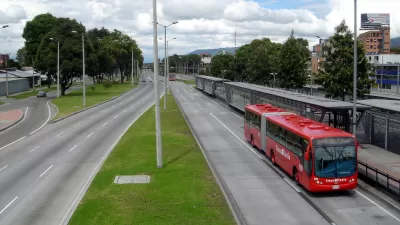
From 1996 to 2006 Bogotá's vehicle fatalities were cut in half, the city employed a number of different tactics around messaging about safety and physical infrastructure investment. "Many elements contributed to this success, including the city’s bus rapid transit (BRT) system, Transmilenio, which debuted in 2000; the creation of an ambitious network of bike lanes, and improved pedestrian sidewalks and crossings," Anna Bray Sharpin writes for World Resource Institute.
The city also sought to tie vehicle fatalities to issues the population was more passionate about. A campaign called "Life is Sacred" talked about not only vehicle fatalities but also evocative safety issues like homicide. Framing the issue as part of a broader health crises "…generated increased support for changes to public transport and public space," Bray Sharpin writes.
Read the full story: “Life Is Sacred”: The Surprising Link Between Reducing Homicide and Traffic Fatalities in Bogotá

Congestion Costing Reality Check, Part 2: A congestion costing critique
There are good reasons to be skeptical of highway industry claims that traffic congestion is a growing problem. Their analysis is often incomplete and biased. Let’s pull back the curtain on some major congestion cost studies.
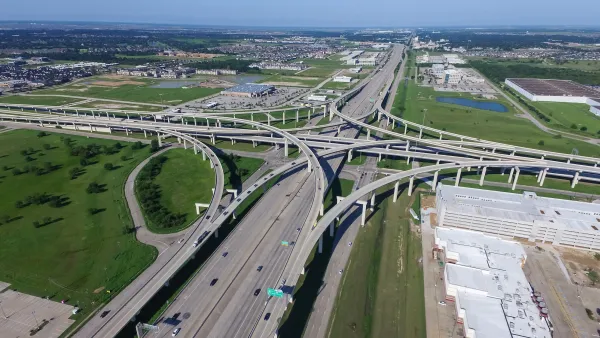
Induced demand is real: Commutes on Houston's 26-lane freeway take 51% longer after expansion
A massive freeway expansion only led to longer drive times, showing that building more lanes won't solve congestion.
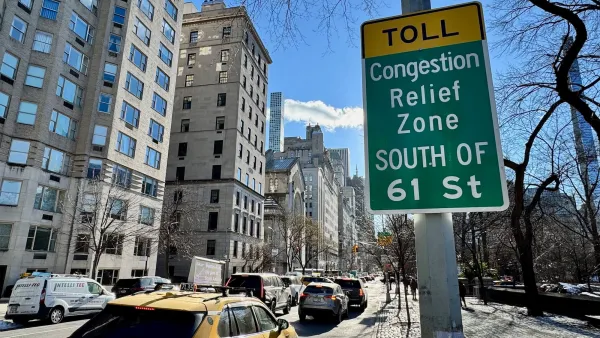
Study: NYC congestion pricing didn't impact parking demand
A city report shows that free parking, not congestion pricing, is the main driver of limited parking demand in the city.

Planetizen Federal Action Tracker
A weekly monitor of how Trump’s orders and actions are impacting planners and planning in America.

The state-sanctioned urbicide of Austin
People don’t kill cities. Freeways do.

Colorado’s Largest Data Center Could Rise Next to Homes — Without a Public Hearing
The proposed campus would consume 11 times the power of Denver International Airport; as it has across the country, opposition mounts.

Judges permit Denver to divert 77,000 acre feet from the Colorado River for reservoir expansion
Overuse and climate change have caused the Colorado River’s water levels to plummet.

Amtrak, CN end decades-long dispute with eight-year agreement
The new operating agreement establishes an updated framework for the companies to work together, including processes to resolve disputes.

Raised interest rates may kill financially vulnerable construction projects
The chief economist at ConstructConnect warns that if construction project owners are negatively impacted by the raised rates, it could result in delayed payments to contractors.

FREE Course: Walkable City 1: Why Walkability?
After describing his path towards focusing on walkability as the essence of good planning, Jeff Speck marches through his five principal reasons for making more walkable places.
Reinventing Malls: Planning Alchemy—Turning Gray Fields Into Gold
The course focuses on the opportunities and imperatives that shape reinvention of mall sites.

KFH Group Inc.
Greater Baltimore Committee
Eagle County Government
The Architects Foundation
University of Cincinnati Online
The Pocatello Development Authority
The Urban Renewal Agency of the City of Pocatello