A study by Zendrive examines how many U.S. drivers can't put down their phones.


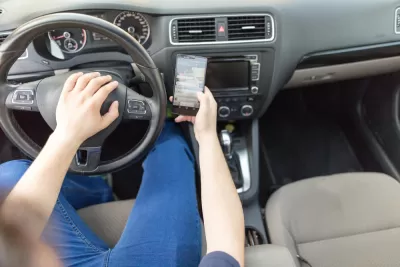
Zendrive, a San Francisco-based tech company, tracked use of cellphones in cars. "Of the 2.3 million drivers it monitored over 5.6 billion miles, some 12 percent were characterized as mobile-phone addicts—calling, texting or scrolling through apps three times more than the average driver," reports Kyle Stock. Zendrive writes that these "addicts" are more common in the American South where the percentage is closer to 17 percent.
This information is particularly interesting in a time when roads are becoming more dangerous. "After decades of gradual declines, U.S. road deaths surged by 14.4 percent between 2014 and 2016. The largest fatality spikes were among pedestrians, cyclists and motorcyclists, all of whom are relatively easy to miss from behind the wheel for a driver glancing at a text message," Stock writes.
Still, it's hard to know how much more dangerous these drivers are, or if this behavior is the threshold for dangerous behavior. Anyone who has waited for a bus at a busy intersection and watched texting drivers go by can see that the problem goes beyond 12 percent of the population.
FULL STORY: Phone addicts text away behind the wheel, ignoring laws


Denver Road Fatalities at Record High in 2023
The city says it is accelerating its Vision Zero initiative to improve road safety for pedestrians and vulnerable road users.
Pedestrian Deaths Fell by Largest Percentage in 15 Years, but Remain Above Pre-Pandemic Levels
After a spike in deaths during the Covid-19 years, road deaths fell to 3,024 in the first half of 2025.

OKC Releases Draft Vision Zero Plan
The plan identifies a High Injury Network and strategies for improving road safety on Oklahoma City streets.

The state-sanctioned urbicide of Austin
People don’t kill cities. Freeways do.

US to reduce Colorado River water deliveries to Mexico
A new Colorado Treaty amendment reduces Mexico’s Colorado River water allocation by 250,000 acre feet.

New Jersey’s second-largest city bans standalone data centers
Jersey City will continue to allow co-location facilities, such as those meant for research institutions that store their own data.

Amtrak not solely to blame for New Jersey commuter rail's unreliability, report finds
A new study from the Garden State Initiative found that NJ Transit’s budget grew 20% across a 4 year period, but reliability declined significantly over the same period.

EPA erases limits on planet-warming pollution from power plants
Under Monday’s plan, power plants would still have some limits on how much mercury, arsenic and other contaminants they can emit.

Phoenix announces new on-demand transit service, more frequent RAPID buses
Both new services will launch in October, and are part of Phoenix's Project Effective Access Solutions for Easing Congestion.

FREE Course: Walkable City 1: Why Walkability?
After describing his path towards focusing on walkability as the essence of good planning, Jeff Speck marches through his five principal reasons for making more walkable places.
Reinventing Malls: Planning Alchemy—Turning Gray Fields Into Gold
The course focuses on the opportunities and imperatives that shape reinvention of mall sites.

Eagle County Government
Harvard University Graduate School of Design
Nashville Planning Department
The Architects Foundation
University of Cincinnati Online
The Pocatello Development Authority
The Urban Renewal Agency of the City of Pocatello
Journal of the American Planning Association