The game company has pledged to obstruct Trump's proposed border wall.


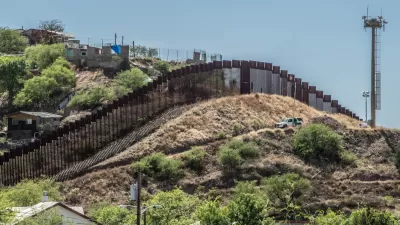
Each year, Cards Against Humanity—the party game known for its irreverence, obscenity, and, occasionally, bigotry—conducts a holiday promotion in the form of a prank, a surprise, or, occasionally, a kindness. This year, rather than send out literal bullshit or pretend to dig a hole through the Earth, the company has made a more ambitious pledge: to stymy Trump’s proposed border wall.
"We've purchased a plot of vacant land on the border and retained a law firm specializing in eminent domain to make it as time-consuming and expensive as possible for the wall to get built," the campaign claims. The Department of Homeland Security has already begun invoking eminent domain to secure property for the wall.
In December, contributors will receive "an illustrated map of the land, a certificate of our promise to fight the wall, some new cards and a few other surprises." The campaign sold out in hours, the Washington Post notes.
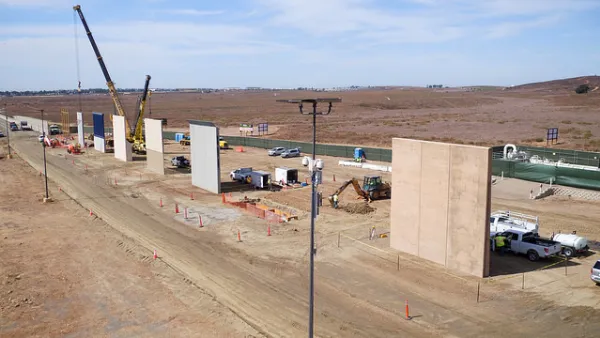
Prototypes for the border wall are on display in California.
FULL STORY: Cards Against Humanity is doing ________ to stop Trump’s border wall

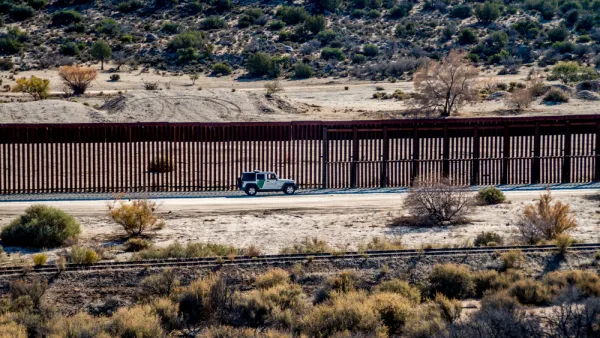
The Failures of the U.S.-Mexico Border Wall
Trump's promised "impenetrable" wall has proven to be anything but.
Report: Trump Willing to Break the Rules to Build Border Wall
Transit agencies, affordable housing developers, and many others might be envious of the kind of leeway sources say President Trump is willing to grant in the name of project delivery.
Homeland Security Waives More Than 30 Laws to Expedite Border Wall
In the drive to begin construction in New Mexico, the Trump Administration has bypassed dozens of federal environmental regulations.

Planetizen Federal Action Tracker
A weekly monitor of how Trump’s orders and actions are impacting planners and planning in America.

The state-sanctioned urbicide of Austin
People don’t kill cities. Freeways do.

US to reduce Colorado River water deliveries to Mexico
A new Colorado Treaty amendment reduces Mexico’s Colorado River water allocation by 250,000 acre feet.

Guerilla urbanists are building DIY bus stop benches in Chicago
A before-and-after of one of the bus stops with a new bench. The new benches are not officially sanctioned or permitted, but the residents who placed them hope they will be the start of a network of DIY benches across the city.

Mamdani overhauls NYC's Vision Zero plan with 100 new policy goals
The overhaul aims to reduce traffic deaths and make streets safer for pedestrians, cyclists and drivers through lower speed limits, new safety infrastructure and more.

Amtrak not solely to blame for New Jersey commuter rail's unreliability, report finds
A new study from the Garden State Initiative found that NJ Transit’s budget grew 20% across a 4 year period, but reliability declined significantly over the same period.

FREE Course: Walkable City 1: Why Walkability?
After describing his path towards focusing on walkability as the essence of good planning, Jeff Speck marches through his five principal reasons for making more walkable places.
Reinventing Malls: Planning Alchemy—Turning Gray Fields Into Gold
The course focuses on the opportunities and imperatives that shape reinvention of mall sites.

Eagle County Government
Harvard University Graduate School of Design
Nashville Planning Department
The Architects Foundation
University of Cincinnati Online
The Pocatello Development Authority
The Urban Renewal Agency of the City of Pocatello
Journal of the American Planning Association