Cleveland Municipal Court Judge Emanuella Groves ruled that the city's HealthLine must use civilians, not police, to check tickets.


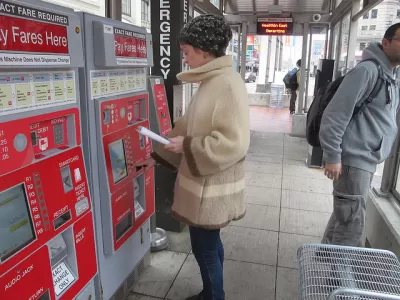
In part because of their proof-of-purchase system, Cleveland's HealthLine runs faster than many buses in cities around the country. "Instead of everyone lining up at the front door to pay one by one, HealthLine passengers pay for a ticket before boarding and enter at any door," Angie Schmitt writes. This makes the system faster and a model for other systems around the country, Schmitt argues. However, the system's enforcement by Cleveland police was ruled unconstitutional by the Cleveland Municipal Court, which ruled that police asking for fare cards amounts to an unreasonable search.
"The decision will slow down the boarding process on the HealthLine for now, but Judge Emanuella Groves laid out a clear way to fix the problem and retain fast boarding procedures: Stop checking fares with law enforcement officers and start using civilian inspectors instead," Schmitt reports.
FULL STORY: Cleveland Police Enforcement of Transit “Proof-of-Payment” Ruled Unconstitutional

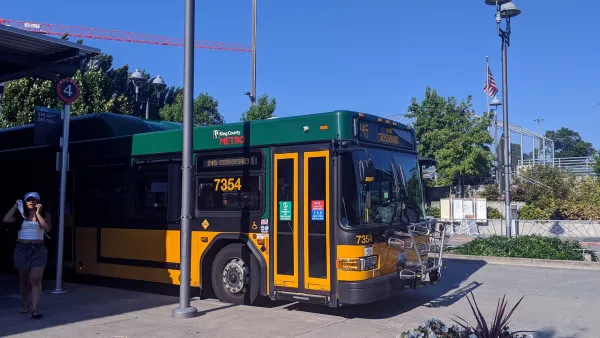
King County Metro adds 3,000 weekly bus trips, more connections to rail
King County Metro and Sound Transit are both making major adjustments to their bus networks to improve light rail connectivity across the region.

Denver mayor announces 'Mile High Line' vision for interconnected bike and transit routes
The mayor emphasized building more housing near transit lines and bike paths, but failed to address planned transit service cuts.
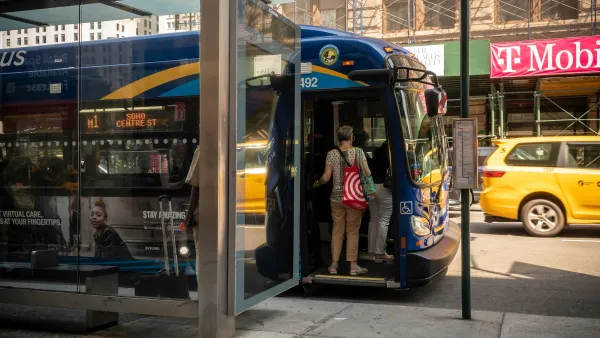
New NYC plan promises to speed up buses by up to 20%
Although the mayor's plan to make buses fare-free faces an uphill battle, a new proposal could make them significantly faster.

Planetizen Federal Action Tracker
A weekly monitor of how Trump’s orders and actions are impacting planners and planning in America.

The state-sanctioned urbicide of Austin
People don’t kill cities. Freeways do.

US to reduce Colorado River water deliveries to Mexico
A new Colorado Treaty amendment reduces Mexico’s Colorado River water allocation by 250,000 acre feet.

5 New England states march closer to 800 megawatt wind energy project
Securing federal approval for the project may be complicated under the Trump administration, which has historically been hostile towards domestic wind power.

Baltimore to break ground on $50 million Transit Priority Project
The project will bring faster bus trips, safer streets and better bike connections to Baltimore.

Airbnb launches $250 million 'last-dollar financing' housing accelerator, makes first investment in Austin
The company will put $6.4 million towards affordable housing development in Texas’ capital.

FREE Course: Walkable City 1: Why Walkability?
After describing his path towards focusing on walkability as the essence of good planning, Jeff Speck marches through his five principal reasons for making more walkable places.
Reinventing Malls: Planning Alchemy—Turning Gray Fields Into Gold
The course focuses on the opportunities and imperatives that shape reinvention of mall sites.

Eagle County Government
Harvard University Graduate School of Design
Nashville Planning Department
The Architects Foundation
University of Cincinnati Online
The Pocatello Development Authority
The Urban Renewal Agency of the City of Pocatello
Journal of the American Planning Association