San Diego's Affordable Homes Bonus Program (AHBP), launched in mid-2016, increases incentives for projects that incorporate more affordable units. Developers are taking notice.



When it comes to inclusionary zoning, Josh Cohen writes, "For many years, San Diego relied on a statewide program and a long-unenforced city ordinance, but in 2016, the city rolled out a new program that builds on the state law by offering more incentives for developers [...]."
The Affordable Homes Bonus Program (AHBP), now in place for over a year, is "an expanded version of the state program that, among other incentives, offers a maximum of 50 percent density increases in exchange for 15 percent rent-restricted units built." California's program, for reference, offers a maximum 35 percent density increase with 11 percent of units rent-restricted.
San Diego developers, it would appear, have been receptive. "To date, 18 market-rate developers have applied for the new program. Between 2005 and 2016, a total of 36 developers applied to the state density bonus program."
However, critics point out that the density increases involved are hardly "modest" and that they violate the spirit of existing community plans.
FULL STORY: San Diego’s Affordable Housing Program Could One Up California


San Diego wants to limit upzoning law to just 16% of transit-adjacent parcels
The city's planning director says some areas are unfit for immediate upzoning due to a lack of resources or hazards such as wildfire risk.
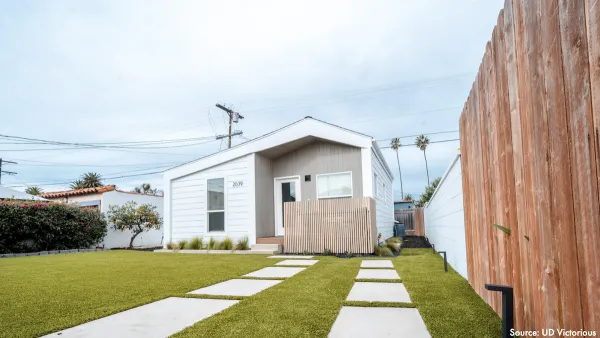
San Diego County ADUs Account for Over 30% of New Housing Permits
A now-expired incentive helped boost ADU applications since 2021 while larger housing projects have stalled.
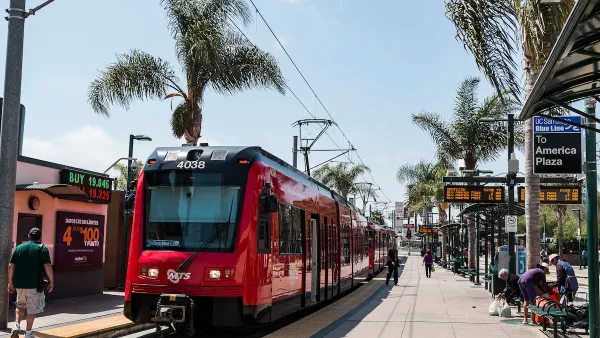
1,000 New Homes Sprouting Around San Diego Trolley Station
Multiple projects, helped along by city and state incentives, will densify the area around the Palm Avenue station.

The state-sanctioned urbicide of Austin
People don’t kill cities. Freeways do.

US to reduce Colorado River water deliveries to Mexico
A new Colorado Treaty amendment reduces Mexico’s Colorado River water allocation by 250,000 acre feet.

New Jersey’s second-largest city bans standalone data centers
Jersey City will continue to allow co-location facilities, such as those meant for research institutions that store their own data.

Amtrak not solely to blame for New Jersey commuter rail's unreliability, report finds
A new study from the Garden State Initiative found that NJ Transit’s budget grew 20% across a 4 year period, but reliability declined significantly over the same period.

EPA erases limits on planet-warming pollution from power plants
Under Monday’s plan, power plants would still have some limits on how much mercury, arsenic and other contaminants they can emit.

Phoenix announces new on-demand transit service, more frequent RAPID buses
Both new services will launch in October, and are part of Phoenix's Project Effective Access Solutions for Easing Congestion.

FREE Course: Walkable City 1: Why Walkability?
After describing his path towards focusing on walkability as the essence of good planning, Jeff Speck marches through his five principal reasons for making more walkable places.
Reinventing Malls: Planning Alchemy—Turning Gray Fields Into Gold
The course focuses on the opportunities and imperatives that shape reinvention of mall sites.

Eagle County Government
Harvard University Graduate School of Design
Nashville Planning Department
The Architects Foundation
University of Cincinnati Online
The Pocatello Development Authority
The Urban Renewal Agency of the City of Pocatello
Journal of the American Planning Association