Spanning eight blocks, plans for the Dallas Smart District include offices, hotel space, and retail. Anchoring the development: a 78-floor tower that would become the tallest building in town.


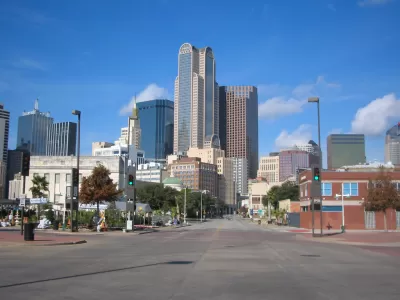
Eyeing a "vacant corner of downtown Dallas," Steve Brown writes, "Builder KDC has teamed up with landowner Hoque Global to plan the more than 20-acre skyscraper campus on the south side of downtown."
Plans for the Dallas Smart District, designed by architect Pelli Clarke Pelli, envision a bold campus of new buildings. "The first phase would include 600,000 to 1 million square feet of office space, an urban grocery store, a food hall, a boutique hotel and green space."
"The tallest building envisioned for Dallas Smart District would be 78 floors, or about 200 feet higher than Bank of America Plaza, currently downtown's tallest building," Brown writes. Additionally, KDC reports that it "included the Dallas Smart District site in potential locations offered for digital retailer Amazon's new $5 billion second corporate headquarters complex."
Read the full story: Bold skyscraper campus would boast tallest building in Dallas
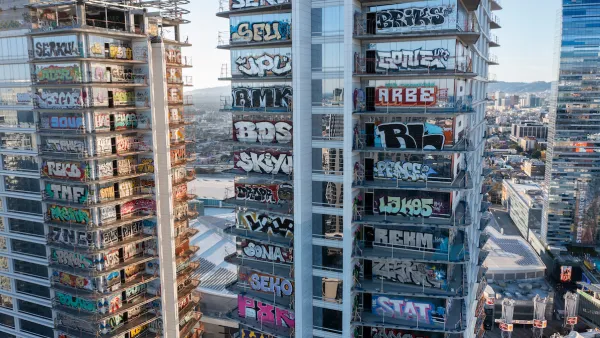
LA’s Abandoned Towers Loom as a “$1.2 Billion Ruin of Global Capital”
Oceanwide Plaza, shuttered mid-construction after its developer filed for bankruptcy, has stood vacant on prime Los Angeles real estate since 2019.
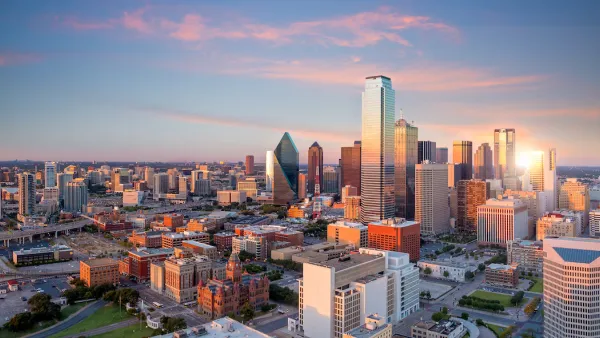
Adaptive Reuse Successes in Dallas
The rise in office vacancies is fueling a boom in adaptive reuse projects.

Largest TOD in North Texas Breaks Ground Near Dallas
The mixed-use complex features over 400 housing units, offices, retail, and park space.

Planetizen Federal Action Tracker
A weekly monitor of how Trump’s orders and actions are impacting planners and planning in America.

California plans to bury El Niño’s downpour
If the state plays its cards right, it may be able to store a billion acre-feet of El Niño’s water in aquifers.

Desperate measures: Advocates weigh draining Lake Powell to fill Colorado River
Draining the reservoir could reduce evaporation losses by a couple hundred thousand acre-feet.

Mamdani’s pied-à-terre tax survives legal challenge
A panel of judges found that the plaintiffs failed to demonstrate injury as a result of New York City's implementation of the tax.

Eastern Nebraska is running out of electricity
Data centers and electrification are straining eastern Nebraska’s grid, throttling economic development.

Seattle passes record-breaking transit services expansion
Proposition 1 will double the city’s transit tax to add 95,000 more bus trips and preserve 180,000 bus trips annually.

FREE Course: Walkable City 1: Why Walkability?
After describing his path towards focusing on walkability as the essence of good planning, Jeff Speck marches through his five principal reasons for making more walkable places.
Reinventing Malls: Planning Alchemy—Turning Gray Fields Into Gold
The course focuses on the opportunities and imperatives that shape reinvention of mall sites.

City of Rosemead
Rutgers University, Edward J. Bloustein School of Planning and Public Policy
One Hundred Miles
University of Michigan School for Environment and Sustainability (SEAS)
Hunter College, City University of New York (CUNY)
The Architects Foundation
City of Cambridge
Montrose County
The Pocatello Development Authority