The city of Los Angeles created a new plan to notify the public about high levels of E.coli in the Los Angeles River after kayakers were exposed to E.coli earlier this fall.


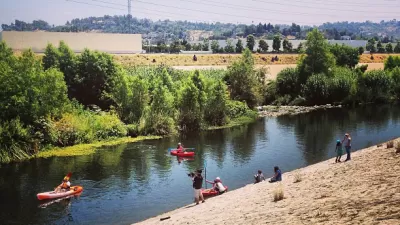
"Seven weeks after failing to notify the public about alarmingly high bacteria levels in the Los Angeles River, city of Los Angeles officials have established a protocol to close the river when the water is unsafe for kayaking and other recreation," reports Emily Guerin.
According to Guerin, "at least five government agencies knew about the E.coli contamination in the days before a kayak race on September 9, but did little to alert the general public or close the river to recreation." The E.coli levels were more than 100 times the federal standard in September.
The new "Los Angeles River Water Quality Testing and Notification protocol" therefore will set new standards for recreation and implement more frequent testing of water quality, among other measures.
FULL STORY: The plan to close the LA River when it gets too polluted


'Transformative' pedestrian bridge planned for LA River in Glendale Narrows
A new bridge will link Griffith Park and the Glendale Narrows Riverwalk.

California Seals 21 Urban Oil Wells in South LA After Decades of Activism
The permanent closure of a long-troubled South Los Angeles oil site marks a hard-fought victory for residents and underscores the growing urgency of addressing hazardous idle wells in communities nationwide.

LA County Adopts First Heat Action Plan
LA County has adopted its first Heat Action Plan, a long-term, people-centered framework to reduce heat risks, protect public health, and adapt communities, homes, and public spaces to a hotter and more dangerous climate.

The state-sanctioned urbicide of Austin
People don’t kill cities. Freeways do.

US to reduce Colorado River water deliveries to Mexico
A new Colorado Treaty amendment reduces Mexico’s Colorado River water allocation by 250,000 acre feet.

New Jersey’s second-largest city bans standalone data centers
Jersey City will continue to allow co-location facilities, such as those meant for research institutions that store their own data.

Amtrak not solely to blame for New Jersey commuter rail's unreliability, report finds
A new study from the Garden State Initiative found that NJ Transit’s budget grew 20% across a 4 year period, but reliability declined significantly over the same period.

EPA erases limits on planet-warming pollution from power plants
Under Monday’s plan, power plants would still have some limits on how much mercury, arsenic and other contaminants they can emit.

Phoenix announces new on-demand transit service, more frequent RAPID buses
Both new services will launch in October, and are part of Phoenix's Project Effective Access Solutions for Easing Congestion.

FREE Course: Walkable City 1: Why Walkability?
After describing his path towards focusing on walkability as the essence of good planning, Jeff Speck marches through his five principal reasons for making more walkable places.
Reinventing Malls: Planning Alchemy—Turning Gray Fields Into Gold
The course focuses on the opportunities and imperatives that shape reinvention of mall sites.

Eagle County Government
Harvard University Graduate School of Design
Nashville Planning Department
The Architects Foundation
University of Cincinnati Online
The Pocatello Development Authority
The Urban Renewal Agency of the City of Pocatello
Journal of the American Planning Association