Notwithstanding a $24.3 billion state budget deficit, CA is well-positioned to receive at least 10% of the Recovery Act funding for high speed rail, says Biden. Two corridors in southern and northern CA have been identified for funding.


"Though California is in the throes of a budget crisis, Vice President Joe Biden said (June 3) that the state's high-speed rail project was well-positioned to compete for a significant share of the $8 billion that the Obama administration has set aside in the Recovery Act for high-speed rail lines -- possibly more than 10%.
The Obama administration is still developing criteria on how to allocate the $8 billion from the Recovery Act for the rail projects, but Biden said federal officials would "look at projects that could be completed quickly and have measurable impact" -- chiefly in taking cars off the road."
"The reason why California is looked at so closely -- it's been a priority of your governor, it's been a priority of your Legislature, they've talked about it, a lot of planning has been done," Biden said.
"State officials have identified two sections of the project that could meet the Recovery Act criteria for high-speed rail of having contracts awarded by 2012 and work completed by 2017. The sections would be those between Los Angeles and Anaheim, at a cost of $3 billion, and between San Francisco and San Jose, at a cost of $4 billion to $5 billion.
The money could pay for laying tracks, building tunnels and bridges, and acquiring right-of-way, according to Mehdi Morshed, the executive director of the California High Speed Rail Authority."
Thanks to Bay Area Transportation News
FULL STORY: Joe Biden says California high-speed rail looking good for federal money

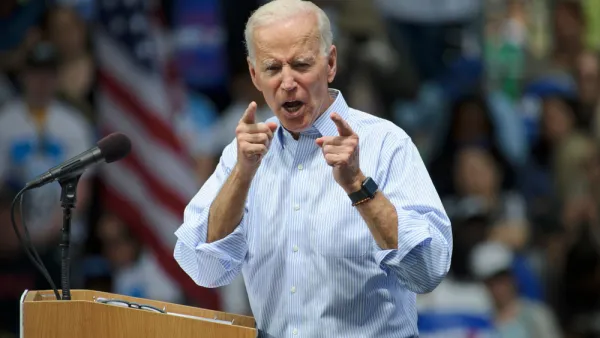
2020 Presidential Campaign: Media Coverage of Climate Strategies
Mayor Pete Buttigieg was criticized for supporting carbon capture and carbon taxes, while Vice President Biden was accused of lifting phrases about carbon capture from a "pro-industry" group. But did the media get these stories right?
$102 Million Brings Chicago-St. Louis High Speed Rail a Step Closer
A $102 million investment by Illinois along with federal funds from the Recovery Act will pay for double-tracking and a new rail bridge to enable 109 mph service on a key section of Amtrak's Chicago to St. Louis high speed rail corridor.
Ray LaHood Stays On As Transportation Secretary
Ending speculation as to whether he would stay or announce his resignation as many in Obama's cabinet have done, and who would replace him should he depart, Ray LaHood announced informally he would stay on as Secretary of the Dept. of Transportation.

Planetizen Federal Action Tracker
A weekly monitor of how Trump’s orders and actions are impacting planners and planning in America.

The state-sanctioned urbicide of Austin
People don’t kill cities. Freeways do.

US to reduce Colorado River water deliveries to Mexico
A new Colorado Treaty amendment reduces Mexico’s Colorado River water allocation by 250,000 acre feet.

Airbnb launches $250 million 'last-dollar financing' housing accelerator, makes first investment in Austin
The company will put $6.4 million towards affordable housing development in Texas’ capital.

Guerilla urbanists are building DIY bus stop benches in Chicago
A before-and-after of one of the bus stops with a new bench. The new benches are not officially sanctioned or permitted, but the residents who placed them hope they will be the start of a network of DIY benches across the city.

Mamdani overhauls NYC's Vision Zero plan with 100 new policy goals
The overhaul aims to reduce traffic deaths and make streets safer for pedestrians, cyclists and drivers through lower speed limits, new safety infrastructure and more.

FREE Course: Walkable City 1: Why Walkability?
After describing his path towards focusing on walkability as the essence of good planning, Jeff Speck marches through his five principal reasons for making more walkable places.
Reinventing Malls: Planning Alchemy—Turning Gray Fields Into Gold
The course focuses on the opportunities and imperatives that shape reinvention of mall sites.

Eagle County Government
Harvard University Graduate School of Design
Nashville Planning Department
The Architects Foundation
University of Cincinnati Online
The Pocatello Development Authority
The Urban Renewal Agency of the City of Pocatello
Journal of the American Planning Association