Environment
World Bank Study Finds Large-Scale Benefits for 'Climate-Smart Development'
A new study by the World Bank examines the benefits for policies addressing clean transportation, energy efficiency in industry, and energy efficiency in buildings in five countries and the European Union.

A 'Mottainai' Neighborhood: Little Tokyo Embodies the EcoDistrict Model
Little Tokyo in Los Angeles was selected to be part of the EcoDistrict Target City program. Global Green is excited to be part of this collaborative effort to promote neighborhood scale sustainability and further the concept of "Mottainai."
Pittsburgh's Allegheny County to Experiment with Drilling under Public Parks
Allegheny County officials have embarked on an experiment to allow companies to drill for oil and gas below one of the county's eight parks. Whether operations expand beyond the initial test site remains to be seen.
Environmentalists Settle Lawsuit on Plan Bay Area
Two down, two to go. Rarely has a regional transportation/land use plan been sued by so many diverse groups. Environmentalists settled with Bay Area regional planning agencies with assurances that the 2017 plan will better account for GHG reductions.
Breaking News: Supreme Court Strikes Down Part of Obama Climate Initiative
In a 5-4 decision on June 23, the Supreme Court ruled that EPA erred in the permitting processes for new carbon-cutting rules. However, most of the Clean Power Plant rule that reduces emissions 30 percent will not be affected.
Detroit's Unpermitted Goat Experiment Ends—Is a Second Chance Possible?
A hedge fund manager recently took it upon himself to bring 20 goats into Detroit as an experiment of urban agriculture. The city quickly shipped the herd off, but fans of goats wonder why these animals shouldn't have a place in the city.
Mapping the Toxic Emissions of the Los Angeles Basin
Knowledge is power when it comes to environmental justice, and a group of students from UCLA has recently armed residents of Los Angeles with a mapping tool that tracks the amount of toxins emitted by local factories.
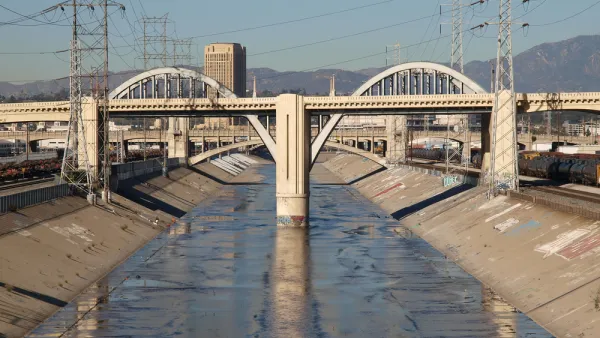
Destabilizing Urban Planning
How can the contemporary concepts in ecology studies—adaptability, resiliency, and flexibility—advance urban planning practices?
A Walk in the Woods Just Got Expensive in Washington and Oregon
The largest private owner of timberland in Washington and Oregon is now charging access fees ranging from $75 to $550 depending on the permit area. The $30 fees for National Forest and state parks passes look cheap by comparison.
Oil Shale (not Shale Oil) and Oil Sands Projects Underway in Utah
A major challenge facing oil companies in the Uinta Basin is how to transport the crude to market. Alignments have been winnowed and the mode appears to be selected - rail. Total cost: $2 billion to extract $30 billion worth of oil and gas reserves.
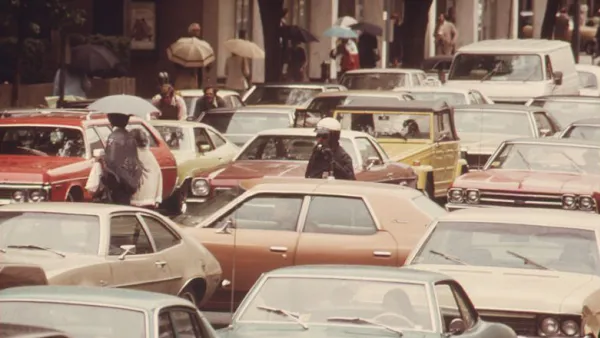
Study: Traffic Forecasts Are Often Inaccurate
In a recent review of the state-of-the-art, two planning researchers conclude that traffic forecasts often fail to accurately predict that demand for new transportation infrastructure.
Personal Air Quality Sensors Compare Pollution Levels
Ben Schiller reports on two new air quality sensors that show you pollution comparisons of the air you are breathing right now.

Urban River Revitalization Across the Globe
Urban Times offers a list of 13 urban river renewal projects spanning from Medellin to Manila.
Big Changes for the National Geographic Atlas of the World Due to Melting Arctic Ice
National Geographic Geographer Juan José Valdés calls the changes in the map of Arctic ice in the 10th edition of the National Geographic Atlas of the World, "the biggest visible change other than the breakup of the U.S.S.R."

40 Visualizations of America and its Relationship with Food
A new post by Vox includes 40 maps, charts, and graphs explain that where and how food works in America.

Urbanists Soak Up Buffalo: PlaceMakers Empty Their Notebooks
Many of you attended CNU in Buffalo last week, but for those of you who couldn't make it, here's a quick collection of a few of the ideas shared.
Will Obama's Climate Initiative Become the Obamacare of Regulations?
EPA's new Clean Power Plan Rule has taken on a political life of its own, with coal states adamantly opposed, helping those who allege that the administration is waging a "war on coal." We also look at the basis of the rule in the 1970 Clean Air Act.
How to Prevent National Forests Becoming 'National Ashtrays'
An editorial calls for innovative policy in post-fire recovery and reforestation. The recent release of the Environmental Impact Statement for the recovery of the Rim Fire should serve as a barometer for a "new public forestry."
How Much Carbon Will Your State Cut under the EPA's New Rule?
A state-by-state breakdown of the U.S. Environmental Protection Agency's proposed carbon reduction rule reveals that some states will have to go far beyond the 30 percent goals for the country overall.
Rainwater Capture as a Game Changer for Drought-Prone Cities
During Australia's 12-year drought, cities like Brisbane cut water usage per-person-per-day by more than half. Andy Lipkis, the founder and president of TreePeople, believes Los Angeles can follow this example.

FREE Course: Walkable City 1: Why Walkability?
After describing his path towards focusing on walkability as the essence of good planning, Jeff Speck marches through his five principal reasons for making more walkable places.
Reinventing Malls: Planning Alchemy—Turning Gray Fields Into Gold
The course focuses on the opportunities and imperatives that shape reinvention of mall sites.

City of Rosemead
Rutgers University, Edward J. Bloustein School of Planning and Public Policy
One Hundred Miles
University of Michigan School for Environment and Sustainability (SEAS)
Hunter College, City University of New York (CUNY)
The Architects Foundation
City of Cambridge
The Pocatello Development Authority
The Urban Renewal Agency of the City of Pocatello









