Environment
The Paradox of Reduced Oil Reserve Estimates
Until recently, California's Monterey Shale was estimated to have the nation's highest amount of recoverable oil. Then the Energy Department revised their estimates, lowering it 96%, which turned out to be bad news for fracking moratorium advocates.
Lean Urbanism: A Century-Old Practice?
A short case study in Lean Urbanism, compliments of Victoria Beach, Manitoba.
First 'Chief Resilience Officer' Begins Term in Oakland
Victoria Salinas was recently named Oakland, California's first Chief Resilience Officer (CRO), a position popping up in municipalities throughout the world.
Sating Food Deserts with Frequent Transit Networks
According to Jarrett Walker, one solution to alleviating food deserts is by providing residents access to frequent transportation networks.
California to Cap Incomes Eligible for Electric Vehicle Rebates
A bill will attempt to bring some equity to the flagrantly inequitable rebate program that subsidizes purchases of Electric Vehicles. Additional subsidies would be directed to low income families. Rebates could also be used for car share and transit.
'Future Ground' Competition Focusing on New Orleans Land Reuse Strategies
Spearheaded by the Van Alen Institute, and supported by the New Orleans Redevelopment Agency, the competition brings new life to some of the 30,000 vacant lots and abandoned structures left over from Hurricane Katrina throughout the city.
Retrofitting New York City's Multi-Family Housing for Resilience
Multi-family housing took the brunt of Hurricane Sandy. Compounding the many challenges to storm-proofing the city's housing supply: 90 percent of the housing in flood-prone areas was built before 1983, when flood-resistance standards were adopted.
How Much Will Gas Prices Rise in California After Cap and Trade?
It could be as low as nine cents per gallon, or as high as 76 cents, writes UC Berkeley energy expert Severin Borenstein. On January 1, transportation fuels are included under California's landmark cap and trade program.
Drought Killing Your Lawn? Spray Paint It
Suburbanites facing fines from municipalities or trying to impress their neighbors have an alternative to keep their lawns shining while still saving water—spray paint.
Testing the Many Aspects of Waterfront Resilience—In New York City
Principals from the Rebuild by Design competition, focusing on Red Hook in Brooklyn and Hunts Point in the South Bronx, discussed their designs and philosophies regarding New York City's resilience at the Center for Architecture.
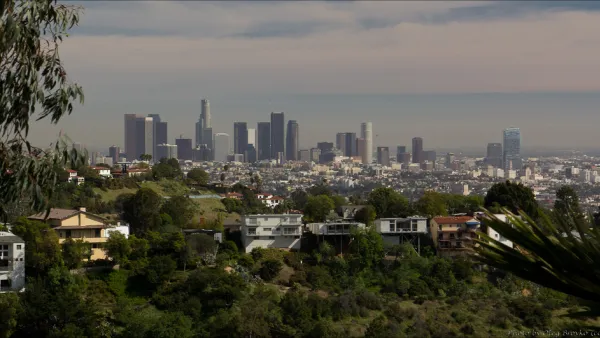
Some Like it Hot: Adapting Los Angeles to Climate Change
Closing out the "Just Add Water" lecture series, four panelists came together to discuss climate change, cultural shifts for sustainability, and adapting Los Angeles's urban fabric for greater climate resiliency in the future.
Fighting Wildfires with Big Data
WIFIRE, a real-time and data-driven simulation, prediction, and visualization technology, combines satellite and remote sensor data to forecast the potential spread of wildfires.
California Cuts 'Level of Service' from CEQA Requirements
The State of California has shifted from measuring "Level of Service," a grade based on how many cars pass through an intersection in a given time, to assessing overall Vehicle Miles Traveled (VMT) in its Environmental Quality laws.
California has the Potential to Power Itself Solely by Renewables
The new paper, "A Roadmap for Repowering California for all Purposes with Wind, Water, and Sunlight," discusses the potential clean energy future for the Golden State by 2050.
International Effort Needed to Prevent Recurrence of Lake Erie Algal Bloom
On Monday, August 4, half a million people in the Toledo, Ohio metro region could once again drink from their water taps after a weekend without safe drinking water due to a toxin resulting from an algal bloom in the city's water supply, Lake Erie.
Can Conservation and Drilling Coexist?
That's the question facing the nation's largest environmental organization (not the Sierra Club but The Nature Conservancy) regarding the management of its preserve in Texas. There is no question for Naomi Klein, who writes about it in her new book.
Floating Vertical Farms Could Deliver and Monitor Food Production in Dense Cities
Known for its density with nearly 20,000 people per square mile, Singapore is changing its food systems strategy to produce more food locally, and reduce food waste.
Poor Planning Decisions Exacerbate Wildfires—Should Locals be Held Accountable?
A new study by the union of Concerned Scientists faults local development policies that place homes in wildfire-prone areas for the increasing cost of wildfires. Should local agencies split the bill for the risks they've permitted?
Unlocking the Biogas Potential in America's Farms
Thinking about "renewable power" often bring hydroelectric, wind, and solar to mind. The informed will recognize geothermal and biomass as major renewables. Biogas, the non-fossil natural gas, is not well known because few facilities capture it.
Georgia Court Upholds Marsh Protections
Those concerned with protecting Georgia’s 387,000 acres of salt marshes (and the $2 billion they bring to Georgia’s coastal economy) won a major victory this month.

FREE Course: Walkable City 1: Why Walkability?
After describing his path towards focusing on walkability as the essence of good planning, Jeff Speck marches through his five principal reasons for making more walkable places.
Reinventing Malls: Planning Alchemy—Turning Gray Fields Into Gold
The course focuses on the opportunities and imperatives that shape reinvention of mall sites.

City of Rosemead
Rutgers University, Edward J. Bloustein School of Planning and Public Policy
One Hundred Miles
University of Michigan School for Environment and Sustainability (SEAS)
Hunter College, City University of New York (CUNY)
The Architects Foundation
City of Cambridge
The Pocatello Development Authority
The Urban Renewal Agency of the City of Pocatello









