When a 10 minute change in layover can cost your system 33% more to run the same route, the nuts and bolts of good scheduling start looking darn sexy.



Welcome to Transit Scheduling 101, a series in partnership with Chicago-based transit planner extraordinaire Joshua Woods, who authors Thoughts About Cities. A follow-up to his popular column, Transit Planning 101, Transit Scheduling 101 is the next installment in his journey to give you the transit planning boot camp you wish you got in planning school. Learn more about Joshua and the inspiration for the column, and read his other installments here.
Over the course of Transit Planning 101, I explored the design principles that underpin Good Transit. In this investigation, I looked at the importance of frequency for making transit useful, sound route design for making transit intuitive, and reasonable bus stop spacing for making transit fast. Notably, all of these considerations are policy considerations; they lay the framework for Good Transit, but do not themselves deliver on this promise.
In his book How to Run A Government: So That Citizens Benefit and Taxpayers Don’t Go Crazy, Michael Barber lays out the following rule of thumb:
“Policy is 10%, and implementation is 90%”
This simple adage applies equally to transit service. An expertly laid service plan, married to an expertly designed transit route is next to useless if the route can’t be operated reliably. Delivering reliability requires sound transit scheduling, the focus of my next series, where you’ve found yourself now: Transit Scheduling 101.
Transit scheduling is the process of turning a transit service plan into detailed, timed trips that drivers and passengers can follow. It involves setting running times, departure times, assigning vehicles and operators, and ensuring the schedule balances reliability, efficiency, labor rules, and customer needs. The goal is to make the service run smoothly for riders while staying realistic for drivers and the agency.

Unfortunately, despite its centrality to the delivery of Good Transit, transit scheduling has a pipeline issue. The best way to learn transit scheduling is to work as a scheduler for a transit agency, but getting a job as a scheduler typically requires previous experience with transit scheduling. See the problem?
In response to this, many new scheduling software products have emerged, designed to make the scheduling process more accessible to newer schedulers. These software products, legacy and emerging, are valuable tools for streamlining the work of scheduling. However, the person who first taught me how to schedule offered the sage guidance that these products are only as powerful as the scheduler that is using them. They will turn whatever trip schedule you feed them into a vehicle schedule. Take the sample schedule below.
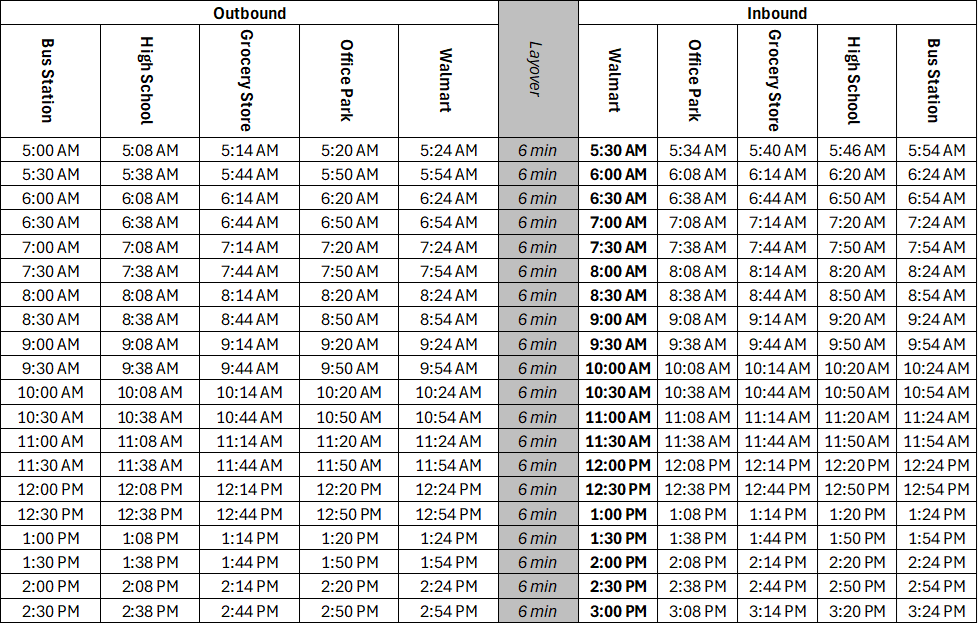
The service runs every 30 minutes, leaving the bus station and the Walmart at the top of the hour and half past the hour. If you fed a scheduling software this trip schedule, it would tell you that this service requires two vehicles to operate, the minimum vehicle requirement given the frequency and run time of the service (more on this in the next article).

However, let’s say you get a request from Walmart employees to shift the Walmart departure back 10 minutes to better align with shift change. That produces this trip schedule.

The service still runs every 30 minutes, leaving the bus station at the top of the hour and half past the hour, but it now leaves Walmart at 10 minutes and 40 minutes past the hour. If you feed a scheduling software this trip schedule, it would tell you that this service requires three vehicles to operate, one vehicle more than the minimum vehicle requirement given the frequency and run time of the service.

Why? Scheduling software works by linking inbound trips to the next available outbound trip, creating the sequence of trips that the vehicle and driver will follow over the course of the day. Before the 10 minute shift, the inbound trips arrived at the bus station at :24 and :54, setting them up nicely to depart six minutes later at :30 and :00 for the next outbound trip. After shifting the inbound schedule back 10 minutes to accommodate the Walmart request, the inbound trips now arrive at :04 and :34, and must wait 26 minutes before the next scheduled outbound trip. This extra downtime, however nice it may be for the driver, triggers the need for an extra bus, and the costs associated. If this is still a little fuzzy, don’t worry. We’ll be taking a deep dive into scheduling math in the next post. For now, just note that blindly trusting scheduling software without a foundational understanding of the scheduling principles that underpin the outputs risks producing inefficient schedules that limit the amount service transit agencies are able to deliver with their limited resources.
Why should I care about transit scheduling?
If you’re an aspiring scheduler, developing an understanding of transit scheduling will help further your career growth by giving you a leg up on other aspiring transit schedulers.
If you’re a transit planner, understanding transit scheduling can help you better understand the downstream impacts of high level planning decisions. One of the most humbling experiences I’ve had professionally was figuring out how to schedule a mess of a service plan (that I created earlier in the planning process)
If you’re a transit advocate, understanding transit scheduling will help you better understand what drives the cost of transit service, how transit service is operated and delivered, and how to communicate service proposals to transit agency staff in a way that is less likely to be disregarded.
If you’re a transit rider, understanding transit scheduling can help you become a transit super user. Let’s take the sample schedule from earlier.

Say you got off the outbound bus at 7:08 AM heading to school. At 8:30am, after first period ends, you realize you left your backpack on the bus. Without an understanding of transit scheduling, your options are to call the transit authority to check if anybody has turned in your bag, or to flag down every bus that comes by the school, hoping that the one you rode earlier still has your bag on it. With an understanding of transit scheduling, you can deduce that, barring a vehicle swap or shift change, the bus you were on will be back by the high school at 8:50 and 9:08 am hopefully with your bag safely stored with the bus driver.
Over the course of Transit Scheduling 101, I hope to leave you with a fundamental understanding of the transit scheduling process for you to use however you find most useful!
In the next post, we’ll dive into the basics of scheduling math ✖️➗.


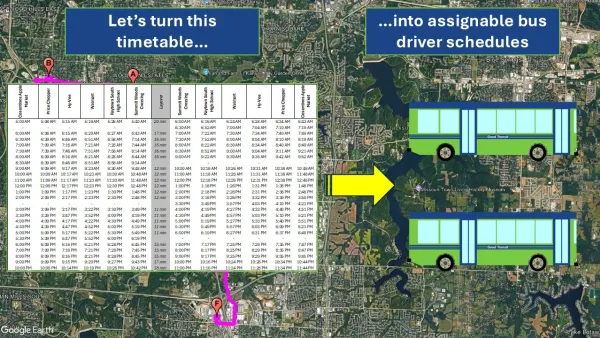
Transit Scheduling 101: Building the operator schedule
A transit operator’s work goes beyond just driving the bus.
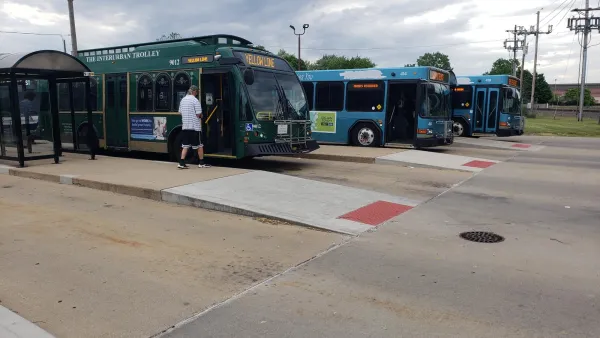
Transit Scheduling 101: Never Cheat the Layover!
Letting drivers take their bathroom break keeps buses running on time, prevents burnout, and might even save the world from tech-fueled social entropy. Why risk it?!
Transit Scheduling 101: Developing A Runtime
Runtime (n) - The time required for the transit vehicle to travel from one end of the line to the other. We'll take a deeper look at runtimes in this installment of Transit Scheduling 101!

Planetizen Federal Action Tracker
A weekly monitor of how Trump’s orders and actions are impacting planners and planning in America.

California plans to bury El Niño’s downpour
If the state plays its cards right, it may be able to store a billion acre-feet of El Niño’s water in aquifers.

Chicago breaks ground on $3 billion megadevelopment
The new neighborhood, titled Foundry Park, will one day host 3,700 residences.

Satanic Place Names
From streams and lakes to valleys and canyons, I mapped more than 1,000 places named after the Devil.

California High-Speed Rail Authority CEO resigns after $600,000 scandal
Under Ian Choudri, the authority used taxpayer dollars to fund first class flights and trips to nightclubs.

Want to study the Missouri River? Soon, you may need unanimous approval from 10 states
Legislation would require 10 governors’ permission to study or build projects moving water outside the basin.

FREE Course: Walkable City 1: Why Walkability?
After describing his path towards focusing on walkability as the essence of good planning, Jeff Speck marches through his five principal reasons for making more walkable places.
Reinventing Malls: Planning Alchemy—Turning Gray Fields Into Gold
The course focuses on the opportunities and imperatives that shape reinvention of mall sites.

City of Rosemead
Rutgers University, Edward J. Bloustein School of Planning and Public Policy
One Hundred Miles
Hunter College, City University of New York (CUNY)
The Architects Foundation
University of Cincinnati Online
City of Cambridge
Montrose County
The Pocatello Development Authority


